Showing posts with label ice. Show all posts

5.13.2015

Rock & Ice Classics

In the past few months I've gotten out and climbed on a few trips to classic areas that were new to me: Yosemite and the Canadian Rockies.


Chris Tirrell working the line
Before those trips I managed the FA of a really fun thin face/bouldering pitch at Trout Creek on the day thatthe wall closed for the seasonal eagle nest intermission. I love crosswords, and crossword-puzzle-builders love the word "Aerie" - which is an eagle nest. The route was named "aerie interlude" in deference to my crossword obsession and the much more famous "Airy Interlude" in the Needles of California. It goes at .12d or so (V5 to a V6/V7) and protects with very thin but bomber cams and wires. Again, no bolts have been used or needed on any route at Trout Creek. Trout opens back up for climbing in a few days (May 15) and I definitely suggest this climb, even just as a great end of the day TR after climbing Gateway or one of the 5.10 routes over to the left.

Jens Holsten and I took a trip to the Canadian Rockies to climb some long classic waterfall ice routes, and we were graciously hosted by our friend Steven Swenson who fit us into his schedule of guests and itinerant dirtbags who overwhelm his condo in Canmore Alberta.
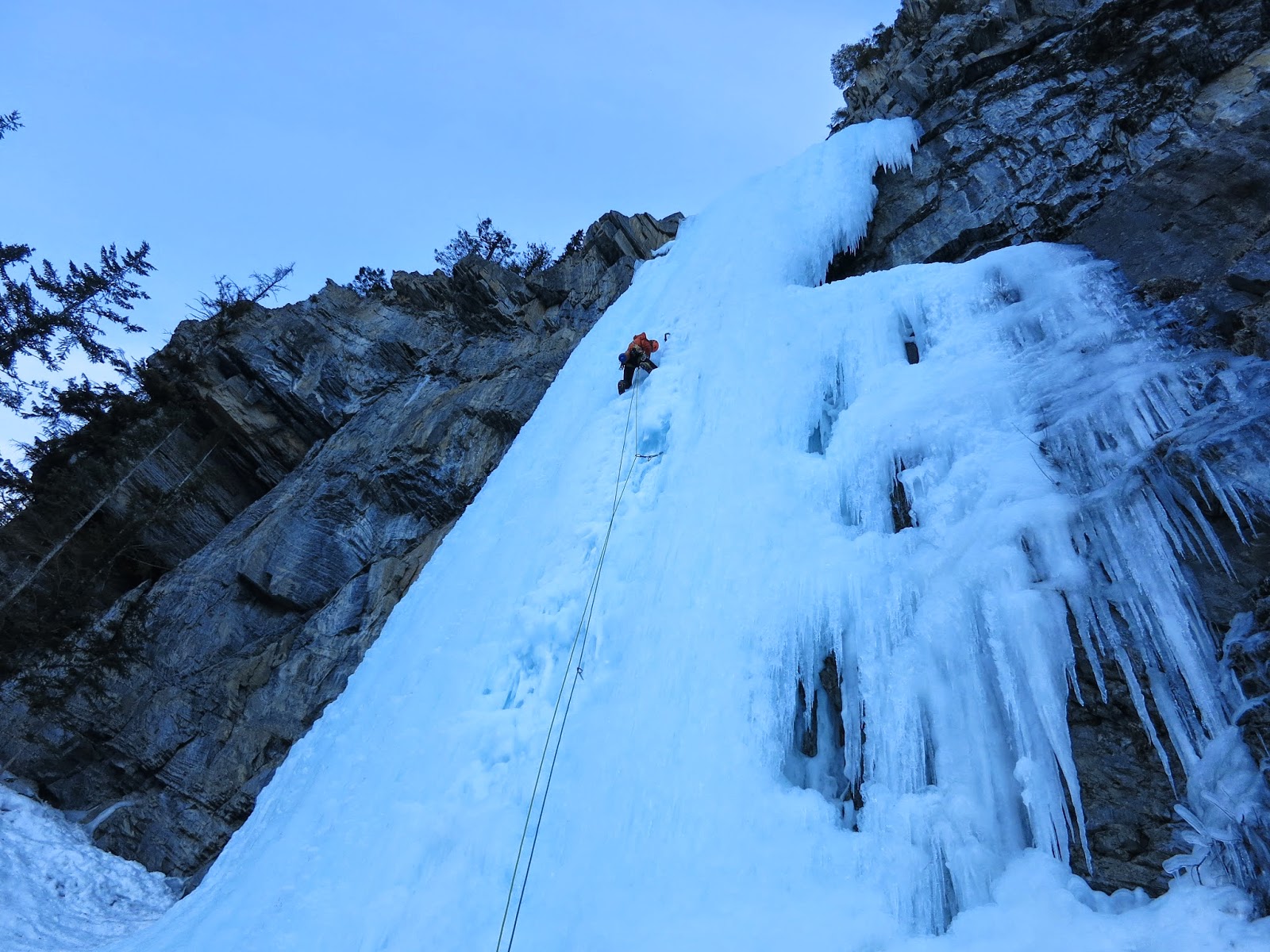
Jens gets us going on Carlsberg Column near Field, BC

We were both amazed by the scale, beauty, and access of the peaks in the Rockies. The ice was fat and blue. Screws actually would hold a fall. This was not Washington slush ice. The first day in the area Jens and I climbed Carlsberg Column in the Field, B.C. area, and then we stopped by Lake Louise and strolled past the amazingly ornate lodge, walked past kids skating and playing hockey, and found ourselves under Lake Louise Falls, which we climbed as well.
The view from one end of Lake Louise
The other end of Lake Louise
The second day we drove up to the Icefields Parkway and began to climb the Weeping Wall, but realized that there was a reason we had the place to ourselves - the ice was turning white and getting sun baked. After reserving a spot at the Rampart Creek Hostel, we backtracked to the trailhead for Murchison Falls, and climbed a route just left of Murchison, a stunning and scenic WI5 called "My Daddy's a Psycho". By "we climbed" I really mean "Jens climbed" -- I basically lead the easier (WI3 and WI4) pitches, while Jens took the WI5 pitches.

Jens on a WI5 pitch of a Murchison Falls variation
Murchison falls is 1-2 miles above the road in a beautiful setting
After a sleepless night in the noisy and sauna-like atmosphere of the hostel bunk room, we got up early and climbed the amazing Polar Circus route, a long and ever-steepening series of frozen waterfalls that is among the most famous ice climbs in the world. After driving back to Canmore and resting for a day, Jens and I were joined by Ian Yurdin of Bend, and our guide/rally car driver Steve Swenson for a trip into the fabled Ghost Valley on the eastern front range in Alberta. Steve's Subaru Outback made it pretty far, despite falling snow, large drifts, semi-frozen river crossings, and 3 terrified passengers. I realized that I had forgotten my crampons, but Steve realized that he had climbed our intended route 3 times already this year, and was happy to let Ian join Jens and I on the climb. We completed a very cold and snowy ascent of The Sorcerer, complete with frozen eyelashes and eyelids on the final steep headwall pitch.


----------------
I heard they designed that rock based on the North Face logo...
Later this spring, I final made a trip to Yosemite where I had the amazing opportunity to climb the Zodiac Wall on El Capitan with Dan Nordstrom who owns Outdoor Research, and with Maria Hines, who owns 3 of the premiere restaurants in Seattle, not to mention being a champion of the Iron Chef TV show. I was mostly along for the ride as a dabbler in all types of climbing, but I learned a lot about hauling, portaledge camping, dawn-walling, harness-sleeping, and aid sketchery. The most memorable event was catching Dan's near-factor-2 fall midway up the route, as his GriGri and 1 jumar were knocked off his harness and free-fell over 1,000' to the deck. The Zodiac Wall is steep, and water falling off the final pitch lands dozens of feet out from the base of El Cap on its steep right side. After a couple days of resting/cragging/bouldering I teamed up with new friend Ricardo Varga, a Mexican sport climber from Portrero Chico, who was just learning to trad climb. We rallied up the classic Astroman, despite getting jammed up behind (5!) teams on a wednesday, including a Euro party engaging in classic Euro shenanigans such as laybacking all the cracks, yarding up a haul bag, and falling out of the Harding Slot and spending hours dangling in space under the gaping maw. I got to lead the whole route apart from an approach pitch, and felt good about on-sighting the famous climb and my first real Yosemite experience. 5.9 is physical, hard, and calorie-intensive in Yosemite!

Ricardo follows the Enduro Corner on Astroman
Ricardo on the Changing Corners pitch
Slotting myself into the belly of the beast, and executing the 180-degree turn. Index flares have taught me well!
Laybacking under the Harding Slot

12.16.2013

Fall is for Sending, Not Falling


As usual, fall has provided a great mix of climbing
opportunities in Leavenworth and around the northwest, with everything from excellent roped rock climbing to bouldering and skiing along with waterfall ice. I took a quick visit to the sandstone and limestone of Mt. Charleston and Red Rock, NV, doing some short sport climbing, a 4-person party ascent of Epinephrine, and a ego-deflating non send of Texas Tower Direct. I also made a few short trips to central Oregon, where the amazing walls of Trout Creek and Smith Rock beckoned. At the American Alpine Club Craggin' Classic, I teamed up with Ben Rueck for the 10-hour "Crushfest" climbing competition. We came in second place, having onsighted and redpointed 67 pitches along the front side at Smith, an even mix of sport and trad routes.

At Trout Creek I "succeeded" in linking all the moves and cleanly TRing the open project left of Gateway. This line is going to be the hardest thing yet at the wall, with a couple boulder problems requiring some serious power and steel finger tips. It will be well protected with small cams and RPs. Trout's at-one-point hardest route, May Fly, put up by my friend Cody Scarpella and repeated by Tommy Caldwell, was repeated this fall by myself, Max Tepfer, and impressively flashed by Mikey Schaefer. It takes a narrowing 5.11/5.12 finger crack which ends at the same height that a nearby finger crack begins, requiring a ~V4 crux and amazing lower 5.11 climbing to the chains. Check out Cody working (and whipping) before the FA (starts at 3:40).


An hour west across the pass from Leavenworth, in Index, a couple days of climbing and working out beta with Jens Holsten and Ben Gilkison resulted in redpointing Narrow Arrow Direct, a gymnastic 5.12c pitch with the crux just below the ledge atop the pitch. I'd like to send every pitch on the "Narrow Arrow" by next spring, and now I've done the two (by far) most difficult lines.

The bouldering this fall was also excellent, with many pleasant, dry, but mid-temperature sunny days. I continued to fall off what might be the closest boulder problem to my house, "Fridge Left" (V8).  But I did manage to complete the classic "WAS" (V8) on my first visit to the problem with a big rowdy crew of locals.

Late fall saw a big early snowfall and then a prolonged clear cold snap. I teamed up with old buddy Kurt Hicks and his friend Dustin to climb the rarely-in-condition Drury Falls above Leavenworth. Drury is one of the iconic ice climbs of the northwest, with an often-dangerous approach, a mandatory river crossing, and a little less than 1,000' of water ice. The early cold stretch with low snow made the approach perfect, and we avoided the sketchy rapids and pre-dawn boat shenanigans by simply rowing across Lake Jolanda below the whitewater, then hiking the opposite bank. The descent is generally mellow and made via tree rappels to the left of the route.
There are 2 ~55m approach pitches below, out of view.


Finally, I headed out to the Entiat Valley for some obscure local ice with Chad "(peak)crusher" Kellogg and Jens "(grape)crusher" Holsten. There are AT LEAST  twice as many major flows which form up during a cold snap than you would expect from the guidebook. Jens sent the WI5 column "What do Ardenvoirs Eat?" and we then ramblied up the CLASSIC second pitch (much easier). To end the day Chad and I lead the 2-pitch "Tyee Falls" - which was similar to climbing slushy snice beneath the gutter of a house, the only difference being that one could not simply traverse or move out from beneath this gutter, because it was the entire route (except the classy cave belay).


3.31.2013

Climbing Magazine - Better Ice Rappels

I recently had an article published in Climbing Magazine about long ice rappels with minimal gear. Check out the piece and the comments posted online:


2.13.2013

Winter, Spring, Spain


P3 of the Goat Beard - about to get sunny and start melting!


The only good climb on Goat Wall
This winter provided a good (though brief) ice cragging season in Washington. I was able to climb several of the Leavenworth-area classics, make an attempt on "The Pencil" (it was fractured at 80' up, so we did 2 other nearby climbs at the head of the drainage) and I climbed a rarely-formed 1,000' ice route on Goat Wall of Mazama, WA, called Goat's Beard.  The Goat's Beard had supposedly not been fully repeated for 20-odd years after the FA. Local ice gurus Craig Gyselinck and Vern Nelson had kept their eyes on the wall, and after they managed the second ascent, their online pictures inspired other local climbers ready for low-hanging fruit. This year it was fatter than ever, allowing continuous ice climbing where the original climbers had used a move or two of aid out a roof of classic Cascades mega-choss. My partner was Nate "ice-crusher" Farr, who had just returned from Canmore and  quickly ran up his pitches, which consisted of 4/5ths of the climb! The highlights were two freehanging WI5 pillars, an overhanging corner that was turning into a waterfall as we climbed it, and pulling our last rappel rope 5 minutes before a major chunk of the upper route exploded down the climb. We did the route in 5 pitches, with a touch of simulclimbing on a couple of them. I highly suggest a 70m rope for those climbers in the year 2035 who will read this during the next winter that this route comes into condition. And I hope for your sake that the Mazama store still sells day-old sandwiches for half-price in the year 2035 as well.

Leavenworth bouldering is GREAT right now. I've been out 3 of the past 4 days and also recently been able to roped climb a few days in preparation for an upcoming trip to Spain, followed by some April time in the desert southwest! A week ago I got off work in Leavenworth at 2:30PM
 and drove the 1:10 to the parking lot at Index, WA where I met with perpetually-motivated local Shaun Johnson for a half-headlamp and half-running-with-water free ascent of Davis-Holland to Lovin' Arms on the ~600' Upper Town Wall. Despite forgetting the belay devices, we munter-hitched our way up and down the route in 2.5 hours and felt lucky to sneak in an early-February climb of this classic route.

I leave for Spain later this week, and will be there for a month and a half sampling the world-famous limestone. Everything I know about Spain is based upon the following video. I expect to enjoy much religious art and many anchovies!


2.06.2010

Cold Comfort


Coming back from Thailand, everything feels extra cold. I usually start shivering when the mercury drops very low, but I think any cold-tolerance I had was destroyed by 5 weeks of tropical temps. So what's a climber to do? On Monday I took my wife out ice climbing, which is conveniently available 10 miles from our house, and 40' from the road. As in this case, there's often an inverse relationship between commitment and comfort.

-


Wednesday I met up with my partner-in-training Scott Bennett, for 10 pitches of barely-warm-enough rock in Eldorado Canyon. Always a humbling place to climb, high-friction weather was ideal for some of the routes we did, including Suparete and Rosy Crucifixion.


Here's Scott sussing out the very suspect gear of Mickey Mouse Die-Rect.


Throughout the day things got colder and colder, with more clouds moving in to obscure the sun. I think it's fair to add a letter grade to the crux of any pitch in which your tips were too numb to feel the holds, and you had to visually confirm that your hands were in the right spots.


Yesterday I completed a local rite-of-passage by climbing the First (northern) Flatiron, accompanied by another Ex-Washingtonian, Jesse Huey. The Flatirons are a series of several sedimentary spires, with long, slabby east faces and steeper, but smaller, west sides. The direct east face on the third flatiron is reported to be over 1,000' of climbing, but that might be from the trailhead. It's also been done in 14 minutes! Jesse joined me on a spur-of-the-moment decision, and having someone to chat with on the route made the climb a lot more fun.


Going from snow to stone, just like stepping over the glacial moat...


Jesse tries not to lose his head on the slabs


Watching Jesse slide helplessly, luge-style, down the icy trail made the descent a lot more fun as well.
On the theme of cold-weather rock climbing (and some of these apply to ice cragging as well), I got ambitious and wrote a few tips and tricks that I find helpful to managing the cold. But ultimately, the smartest thing might be to practice your simulclimbing or soloing, and just stay moving to keep warm.


Tricks for Cold Climbing
  • Shoes go in the jacket between leads, so you don't have to put on damp and cold shoes.
  • Strap 'hot hands' packets to to your wrists, but not too tightly. We have a lot of blood flowing just under our skin on the wrists. the idea is to warm it without cutting off circulation. Jackets with velcro wrist-cuffs will help as well.
  • Fill your water bottle with warm water or tea in the morning. Hot Gator-ade is also better than you might think.
  • Thermos of Hot Water + thermos lid + Instant Oatmeal packet (Brown sugar flavor) = warm, sweet, hydrating snack
  • Put your energy bar in warm spot (inner jacket pocket) for 10 minutes before chomping down. Chipped teeth (and scary dental bills) make frozen Snickers the real crux of the day.
  • If you don't have a thermos or water-bottle cozy, a wool sock around the bottle will keep your nalgene warm for hours.
  • After sipping from your camelback hose, blow all the water back into the main reservoir at the end of each drink. Water in the hose freezes much sooner than in the bladder inside your pack.
  • With winter winds and extra layers over your ears, hearing commands is especially hard. Learn to communicate belay commands with a simple set of rope tugs.

11.12.2009

Ice Capades


Sunny days and quick approaches. This is winter in the 'rado.


I've had a great few days around Denver, enjoying rock and ice climbing, and starting work at an Italian restaurant only 7 blocks from home.

Last week I teamed up with Justin Selmanson who works at Trango, and we climbed "The Naked Edge" in Eldorado Canyon.


The route follows the sun/shade line, up the center of the photo.

I lead 6 of the 7 pitches and had a great time watching the party below us, which included a blind climber. Yep, Eric Weihenmayer and 2 others did the Naked Edge right behind us, and moved very fast. Their climb was filmed from several locations around the park, and Cedar Wright had fixed ropes for some close-up footage. I think the video may end up with other clips here. If you scroll down that site a bit, you'll see a video Cedar edited from our route on Mt. Stuart in July. On the walk off we ran into Malcolm Daly, also of Trango, who had us pose and look scared. It was pretty natural for me.


On the weekend I made my second trip to Thunder Ridge, a hidden area of beautiful granite face climbing. I was with Canadian Gordon Mcarthur, and we had a good time on the massively-overhanging "G-Route" and the only slightly overhanging "Reptile Tears".


Reptile Tears is 100' of overhung patina edges and flakes, is rated 5.10+ and protects with one set of stoppers. Amazing route.


Yesterday, my friend Jason Killgore roped me into ice climbing at Lincoln Falls, an area near Breckenridge. We had a good time on a half-dozen easy pitches of fat ice, and a bit of mixed terrain, leaving at noon so I could start work that afternoon.


During cold snaps, ice is reputed to form in Clear Creek Canyon, with would make for a 15-minute drive from my front door. I hope it happens this year.

12.21.2008

The Iceman Cometh


A week ago I was out sport climbing in a T-Shirt Nate Farr, an old friend from WWU who was one of the first people I ever climbed with. This week things were a little different. A big scary mass of Canadian air was on its way down (we send them acid rain, they send us arctic air, free trade at its finest!). With local TV forecasters hyperventilating about the chance to fire up the storm-tracker Doppler-8 infra-red mach3 Gillette Schick-Quatro weather radar, I knew I was in for a week of accessible waterfall ice, and unavoidable weather hype. While the later soon grew hyperbolically comedic, the former provided the chance for three days of climbing ice only 20 minutes from Vancouver, WA.


On Tuesday I skipped out on work at Cilogear and met up with Tim Holscher, to investigate a few flows in the Columbia River Gorge. We found 2 routes, each two pitches long, featuring solid WI3 with fat ice and little wetness.


After that, we did our best Somali Pirate impersonation, by hijacking a barge and motoring over to the Oregon side of the river. Here we went on a wild goose chase looking at more routes that weren't in condition yet, and not finding any wild geese either.

We did come across an amazing flake of ice that seemed to defy gravity, and eventually climbed at "Mist Falls" which is a pretty little amphitheater completely coverd in thick ice. This made for a fun, if very mellow end to the day.


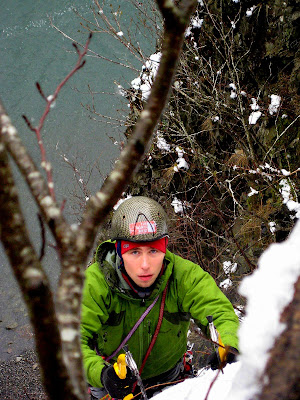
On Friday Tim and I met up again, this time to investigate a series of flows that form off the Columbia River beach, on the Washington side. We came across 6 different routes, although only 3 of them were in climbable condition. Local TV reporters, high on overtime pay and truckstop coffee, gave dire warnings and prognostications of certain death to anyone crazy enough to venture out. We ignored them and found calm conditions, occasionally sunny skies, and an awesome 4-pitch linkup that put us 1000' above the river, clamoring over a guardrail onto highway 14.


The first pitch started out steeply, rising directly off the beach. As Tim climbed higher, he bemoaned the ice's decreasing thickness. The ice screws may have been crappy, but hey, at least the rock was total garbage!


After 60m and a little extra, Tim belayed from a tree and I followed the pitch before leading up a WI3 jungle for a short top-out pitch.



From here we collected our bearings, battled three rounds with blackberry bushes (sticker bushes 2, humans 1) and eventually reached the base of a 2-pitch flow which lead the next cliff band. I took the first pitch, which was mostly fun WI2, with a vertical step toward the top.


Tim led up the final pitch, which was featured and beautiful.


From the top we tromped up to the highway, overcame the afore-mentioned guardrail, and began to hike back toward our car. It had now begun to snow, and it took us to while to realize that in order to reach our car we'd have to catch a ride or walk back 3 miles along the highway, and descend about 1000' back to the base of the route. Past experience has shown that one's success in getting a ride is inversely proportional to the number of sharp pointy objects he or she is carrying.


Given a pair of crampons and two ice tools each, I pegged our chances of success as commensurate with the likelihood that local tv newscasters wouldn't finally be wetting their pants about the arrival of actual snow. However, my pessimism was unjustified, as we were soon given a ride, avoiding all but a mile of walking.


On Saturday we headed out one final time, although this time the feds had stepped in, with the National Weather Service issuing a blizzard warning for the area. Given the weather of my upcoming climbing destination, I figured getting out in the wind might be useful training. I kept thinking this until we went to make our first rappel, off a small promontory of land. I waited between gusts before throwing our rope over the edge, only to see the wind blow it back up at my face and shoot it out sideways at 40 MPH, leaving the ends of both strands 100' to our left, and uphill of where they'd started.


We eventually made it down to the wall, and were rewarded with a steep mixed (mostly rock) start and interesting ice features on the rest of the route.


Today I pulled my randonee skis out of the bag and did a lap around the neighborhood. The roads were covered in snow, nobody was driving, and the absolute quiet was astonishing. I could only stand it for about 10 minutes before I had to run inside. After all, the dopler-8 storm tracker had updates to report!