Showing posts with label trad. Show all posts

5.13.2015

Rock & Ice Classics

In the past few months I've gotten out and climbed on a few trips to classic areas that were new to me: Yosemite and the Canadian Rockies.


Chris Tirrell working the line
Before those trips I managed the FA of a really fun thin face/bouldering pitch at Trout Creek on the day thatthe wall closed for the seasonal eagle nest intermission. I love crosswords, and crossword-puzzle-builders love the word "Aerie" - which is an eagle nest. The route was named "aerie interlude" in deference to my crossword obsession and the much more famous "Airy Interlude" in the Needles of California. It goes at .12d or so (V5 to a V6/V7) and protects with very thin but bomber cams and wires. Again, no bolts have been used or needed on any route at Trout Creek. Trout opens back up for climbing in a few days (May 15) and I definitely suggest this climb, even just as a great end of the day TR after climbing Gateway or one of the 5.10 routes over to the left.

Jens Holsten and I took a trip to the Canadian Rockies to climb some long classic waterfall ice routes, and we were graciously hosted by our friend Steven Swenson who fit us into his schedule of guests and itinerant dirtbags who overwhelm his condo in Canmore Alberta.
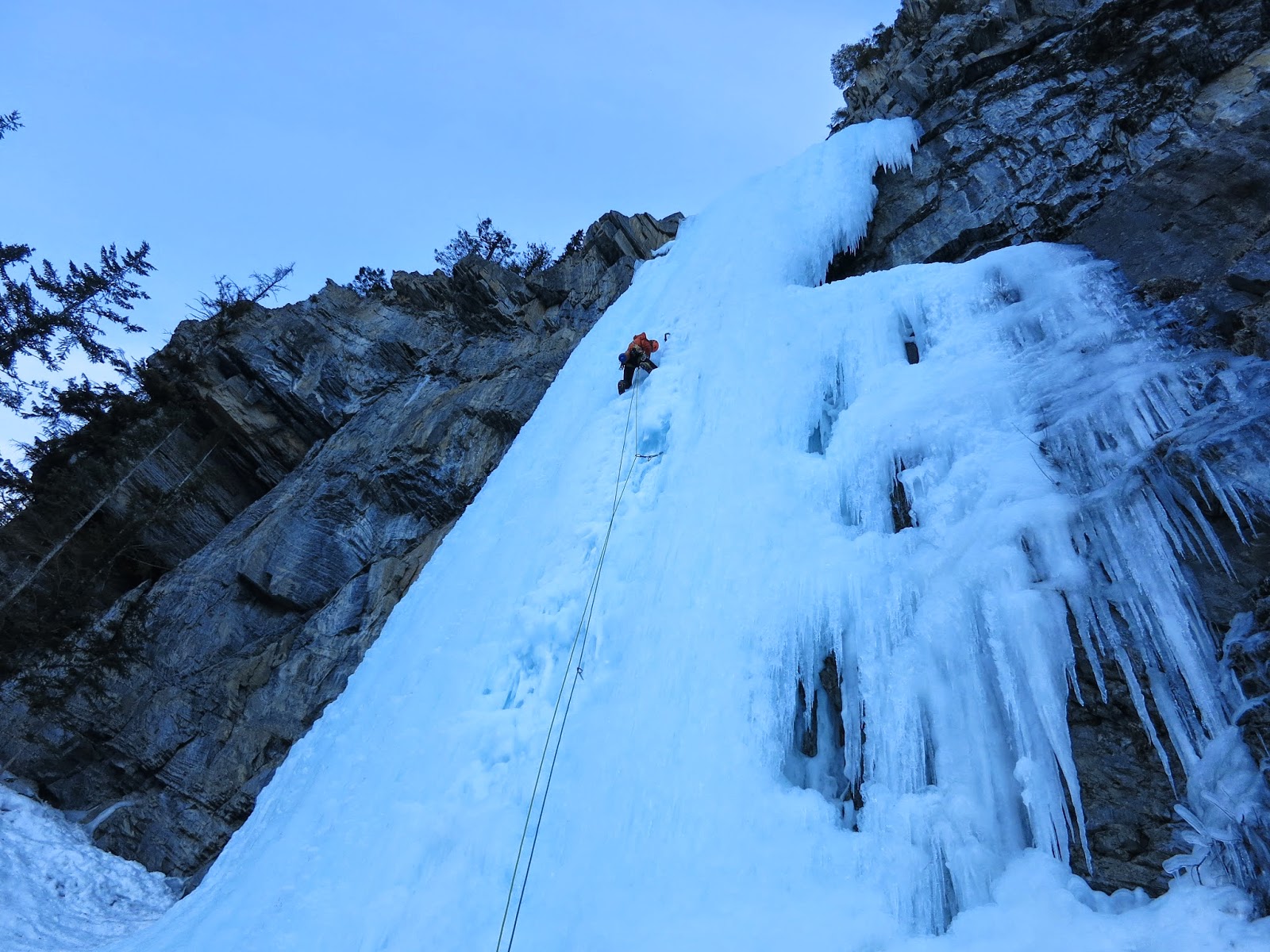
Jens gets us going on Carlsberg Column near Field, BC

We were both amazed by the scale, beauty, and access of the peaks in the Rockies. The ice was fat and blue. Screws actually would hold a fall. This was not Washington slush ice. The first day in the area Jens and I climbed Carlsberg Column in the Field, B.C. area, and then we stopped by Lake Louise and strolled past the amazingly ornate lodge, walked past kids skating and playing hockey, and found ourselves under Lake Louise Falls, which we climbed as well.
The view from one end of Lake Louise
The other end of Lake Louise
The second day we drove up to the Icefields Parkway and began to climb the Weeping Wall, but realized that there was a reason we had the place to ourselves - the ice was turning white and getting sun baked. After reserving a spot at the Rampart Creek Hostel, we backtracked to the trailhead for Murchison Falls, and climbed a route just left of Murchison, a stunning and scenic WI5 called "My Daddy's a Psycho". By "we climbed" I really mean "Jens climbed" -- I basically lead the easier (WI3 and WI4) pitches, while Jens took the WI5 pitches.

Jens on a WI5 pitch of a Murchison Falls variation
Murchison falls is 1-2 miles above the road in a beautiful setting
After a sleepless night in the noisy and sauna-like atmosphere of the hostel bunk room, we got up early and climbed the amazing Polar Circus route, a long and ever-steepening series of frozen waterfalls that is among the most famous ice climbs in the world. After driving back to Canmore and resting for a day, Jens and I were joined by Ian Yurdin of Bend, and our guide/rally car driver Steve Swenson for a trip into the fabled Ghost Valley on the eastern front range in Alberta. Steve's Subaru Outback made it pretty far, despite falling snow, large drifts, semi-frozen river crossings, and 3 terrified passengers. I realized that I had forgotten my crampons, but Steve realized that he had climbed our intended route 3 times already this year, and was happy to let Ian join Jens and I on the climb. We completed a very cold and snowy ascent of The Sorcerer, complete with frozen eyelashes and eyelids on the final steep headwall pitch.


----------------
I heard they designed that rock based on the North Face logo...
Later this spring, I final made a trip to Yosemite where I had the amazing opportunity to climb the Zodiac Wall on El Capitan with Dan Nordstrom who owns Outdoor Research, and with Maria Hines, who owns 3 of the premiere restaurants in Seattle, not to mention being a champion of the Iron Chef TV show. I was mostly along for the ride as a dabbler in all types of climbing, but I learned a lot about hauling, portaledge camping, dawn-walling, harness-sleeping, and aid sketchery. The most memorable event was catching Dan's near-factor-2 fall midway up the route, as his GriGri and 1 jumar were knocked off his harness and free-fell over 1,000' to the deck. The Zodiac Wall is steep, and water falling off the final pitch lands dozens of feet out from the base of El Cap on its steep right side. After a couple days of resting/cragging/bouldering I teamed up with new friend Ricardo Varga, a Mexican sport climber from Portrero Chico, who was just learning to trad climb. We rallied up the classic Astroman, despite getting jammed up behind (5!) teams on a wednesday, including a Euro party engaging in classic Euro shenanigans such as laybacking all the cracks, yarding up a haul bag, and falling out of the Harding Slot and spending hours dangling in space under the gaping maw. I got to lead the whole route apart from an approach pitch, and felt good about on-sighting the famous climb and my first real Yosemite experience. 5.9 is physical, hard, and calorie-intensive in Yosemite!

Ricardo follows the Enduro Corner on Astroman
Ricardo on the Changing Corners pitch
Slotting myself into the belly of the beast, and executing the 180-degree turn. Index flares have taught me well!
Laybacking under the Harding Slot

5.12.2014

Index LWS - Guilty as charged


Living only 65 miles from Index, WA, I have become a frequent visitor in my 2.5 years of Leavenworth residency. Even with only a few hours to climb, it is a perfect sport for solo TR laps or a quick after-work stop. Often I will get asked about climbing around my home in Leavenworth, to which I will rave about the bouldering, rave about the alpine climbing, and say that for roped days, I head to Index. Sure 65 miles is a bit of a drive, but with Stevens Pass marking the halfway point, I can combine climbing with skiing or merely observe the changing seasons. And unlike driving from Seattle, I don't have to pause at a single stoplight, stop sign, interchange, or traffic jam. Unlike many of the Leavenworth crags, the longest approach is 25 minutes on a very nice trail, so even living in Leavenworth, I can get to the Upper Town Wall faster than I can make it to many of our "local" climbs. To many climbers, Index sports a 3 or 4 month climbing season. But the walls are in fact climbable 12 months out of the year.  Last winter, within a few days of climbing a 1000' lowland ice climb, I spent a sunny 17-degree afternoon cragging at the Lower Town Wall with Ben "Crusher" Gilkison, while the upper wall sported a 400' ice dagger which crashed to the ground at mid-day. In winter there are no leaves on the trees, the low southern sun beats onto the wall all day, and the friction is at its peak. I have developed an advanced case of what Ben calls "Lower Wall Syndrome". In light of the guidebook aspirations of my friend Matt Van Biene I wanted to describe a few pitches which never get climbed solely for lack of information, and provide a quick list of routes ranked by difficulty.

The obscure-for-no-good-reason routes (and how to get to them)

Each of these is a three or four star classic:

1. P3 of Japanese Gardens 5.11a - Everyone and their mom has climbed the classic Godzilla-P2City Park-Slow Children linkup. Next time you are standing at the base of Slow Children, simply do a belayed walk about 35' to the left, and you will find yourself beneath another stellar finger crack, similar to Slow Children, which pulls an awesome roof and uses the same rack you've already got. This is called P3 of Japanese Gardens. It is just as good as Slow Children. It gets 1% the traffic, and needs more.

2. Leaping Lizards 5.10 - Ever want to go hang a rope on Natural Log Cabin or Narrow Arrow Overhang? How about access 2 awesome 5.10 crack pitches that nobody ever does? (NAD P2, P3) Simply looking for a another warmup?(easily linked through Godzilla in a 50m pitch) - From Godzilla step immediately right, clip a bolt, and then follow the crack and corner up and right, passing a couple more bolts and some gear placements, leading to a memorable final move. This belay ledge allows one to scramble a few meters right and reach the belay between the next two routes.

3/4. Pitch 2 and Pitch 3 of Narrow Arrow Direct 5.10b, 5.10d - Although the first pitch of NAD is 5.12c with a powerful bit of climbing up top, the next two pitches are splitter moderates that take perfect gear the whole way. They are never climbed. Access via: Climbing Shirley and stepping left, climbing Leaping Lizards and belayed scrambling right, or climbing Thin Fingers and belayed scrambling left.

5. Batskins P2 - 5.11d - Some bolts and some gear, some crack climbing and some face moves, some steep bits and a touch of slab, this pitch has the goods. Get to the base of it by rapping 35' down and hard left from atop Godzilla. Or lead all of P1 (5.12b)

6. Sagi-Horse 5.10+/5.11- Climb Sagittarius to the second anchor, then climb out the Iron Horse roof, on the left. This is labeled 5.11+ or 5.12a depending on the guidebook, but it's not that hard. Finishing via the left side of the roof also makes for a straighter rope line and less zig-zaggery.

Grades: Index should stay uniformly sandbagged. It should just be internally-consistently-sandbagged. That is to say, a 5.12b ought to be a touch easier to redpoint than a 5.12c, which is a touch easier than a 5.12d. They can still all be harder than a 5.13 in Indian Creek or a 5.14 in Tensleep, and that's ok. Ben Gilkison, one of the most accomplished LTW climbers ever, had this to say in regards to the grades after putting up a new route over the winter:

Regarding its grade, it felt around 12d to me, give or take.  Who knows though, perhaps it is only like 11d, like everything else at Index -wink.  Officially, I'm calling it 5.12, so nobody thinks I'm a fluffer.  In comparison, I thought it harder than routes like Numbah Ten, Narrow Arrow Direct, Stern Farmer, and Power Horse.  Please, take all this information with a grain of salt, or a heaping spoonful if you prefer.
And similar sentiment has been written by Mikey Schaefer, another of Index's most accomplished climbers:


 I can't really figured what to grade the pitch so I'm going to say Index,11d which in my opinion has ZERO correlation to Yosemite Decimal System. IF it were in Yosemite, it would probably be somewhere closer to 12/12+

So here's my personal ranking of some famous LTW testpieces. I'm 5'8" with no power, short arms, and a propensity to kneebar. Your mileage WILL vary. No Grades given except as bookends. I'll only list routes I've sent, so ideally the list will fill in over time.


Sagi-Horse. December 8th. 17 Degrees.
Shirley 5.11c - Less-than-stellar rock and easier moves lead to a classic stem finish above your gear.

Japanese Gardens P1  - I have done this one too many times to count, but would do it again today. I remember being so psyched and scared leading it for my first time, finding the highest possible pro to place beneath each crux, and clipping the highest wire with a single locker to minimize the fear and fall distance.
Iron Horse (short or long, the cruxes are both before anchor #1)
Ten Percent Meteorological Vinculation P1  - Stellar, keeps you on your toes
Stern Farmer - This seems to be harder for everyone else. Kneebar the crux. Tight hipster jeans help.
Batskins P1 - Being taller would help, but so would being a better climber. Really demanding of good composure up high and a good test of core strength and open-handed power.
Narrow Arrow Direct (right) - 5.11- on steep and big features for 80', to a V5 with the right beta (though refining this beta took Jens Holsten and myself 2 or 3 sessions to get just right) - I could see this being easier than the above last couple routes for a powerful climber good at slopey crimps.
Numbah Ten - This one gets a .12b in the guidebook. When I was working on it, Andrew Philbin remarked that the hardest move of the Full Amandla (.13d) is possibly at bolt #2 of Numbah Ten. Andrew has sent nearly every pitch at the LTW. You do the math...
Power Horse - Climb Iron Horse to the first anchor, but use it merely to clip off all the leftover widgets you wont need for the bolted section above, as you span left and finish via the 2nd half of Amandla. Both guides show (or even describe) a mid 5.13 crux somewhere on the arete, but it is not that hard.
Narrow Arrow Overhang 5.13-  A wild line with a strange history. The climbing to the first anchor was freed by someone long ago, and is 5.10c or so. The climbing from anchor #1 to #2 is a very shallow inset, which is insecure pressing and chimneying protected by RPs behind your butt. This is brilliant 5.11c (ish) - and the top part of the climb is when things get interesting. The next 20', above anchor #2, is a vertical arete which was first toproped cleanly by Chris Schlotfeldt, and he rated these moves 5.12d on TR. Sometime later, two bolts were added as lead protection by someone else. The roof "boulder problem" above this arete had climbed via traversing in from a ledge on the right (sent by roof crackspecialist Dick Cilley, and rated 5.12b, which seems an absurd rating, even for just 15' of climbing. Although LTW .12b has a bit of a mystic about it) - In 2008 Gilkison added an anchor above the roof at the 35m mark (where the climbing changes to 5.9), and sent the whole thing grading it low 5.13.
The roof on NAOverhang between anchors #2 and #3


It sounds like Ben's new route Nobody Tosses A Dwarf! will fall someone in the upper part of that lineup. And after TRing P2 of Stern Farmer, I think it would end up between Batskins and NAD. P2 of Ten PErcent, City Park and Amandla are the only routes harder than these listed, and nobody who has sent one of those has also sent the others. They must both be rated 5.11d.

4.16.2012

New Route in Red Rock!


Above all other peaks and walls in Red Rock Nevada, Mt. Wilson looms the most impressively. I'd never climbed Mt. Wilson, but after climbing The Warrior on Cactus Flower Tower, I knew what route I wanted to attempt. From atop of the spire, I'd seen a line of cracks leading up for a few pitches from the Wilson/Cactus Flower Tower col, on the NE Face of Wilson. How better to try a new route on Mt. Wilson than by heading up a new line on Cactus Flower Tower to get there?

I was easily able to entice former Washingtonian Chris Weidner into joining me, and we began with a chimney just left of The Warrior. 
P1 was wide climbing, and just mossy enough to make me feel at home.

Roughly 1000' of great 5.9 crack climbing lead us to the final anchor on The Warrior, and the easy romp to summit #1. 


A belayed downclimb and one rappel landed us in the windy col.


Downclimbing to the col

The route on Wilson was only 3 belayed pitches, but the middle one had long and varied crack climbing that is THE BEST crack pitch I've climbed in Red Rock. 
Perfect cracks!

This route (we named it the Cactus Connection) would be an easy way to finish after any route up Cactus Flower Tower. There are certainly other obvious new routes available there too.


Here are a few photos of the new routes.

Chris Weidner posted info here:


It amazes me that one can still walk up to a feature easily visible from the highway in one of the nation's busiest climbing spots, and establish two new routes ground-up, onsight, and boltless in a day. 

Atop Wilson amid raging winds

We found a very casual descent from Mt. Wilson into Oak Creek, past Solar Slab, and out to our car.

  1. Walk straight away from the Hwy for ~25 mins, staying on the ridge crest
  2. Soon after the ground changes from red sandstone to grey limestone, hang a hard right down toward Oak Creek.
  3. As long as you are descending a drainage near the limestone/sandstone interface (err skier's left) you'll be easily able to walk back to the car using just a single 40' rappel from a fixed rope roughly halfway down the wash. Everything else is mellow walking.

4.11.2012

Rocking Red Rock

I was in Red Rock for a week, climbing, teaching at the Red Rock Rendezvous, and working on some product design sessions for Outdoor Research.


I climbed a bunch of excellent routes:

  • Cloud Tower
  • Rainbow Wall
  • Ancient Futures
  • Adventure Punks
  • Spring Break / Tarantula / Gotham City
  • Texas Hold 'Em
  • Velvet Tongue (some of)
  • Cactus Flower Tower
  • Mt. Wilson
In Red Rock, it seems to make the most sense to basically ignore 70% of the routes there (anything on light-colored rock, most of the single pitching) and focus on the swaths of amazing stone, where every route is good.

Black Velvet Canyon, Brownstone Wall, South Side of Juniper Canyon, South Side of Pine Creek, and a few other smaller areas seem to house the best concentrations of good routes. Almost all of the good multipitch climbing faces north, but we did spend one colder day climbing some amazing overhung trad routes (Spring Break area) in Icebox Canyon.

Ancient Futures was really really good- definitely worth a lot more traffic than it gets, which isn't much. We also rapped the route with 1 70m rope (from atop the Elephant's Trunk on Epinephrine) and I posted some beta here. 

Velvet Tongue - I'm definitely going to be back for this one. The climbing is unforgettable, the wall is shady and quickly approached, and there are lots of new bolts! Now I just need to practice uncontrolled falls into and out of a corner. 

Cloud Tower

Panhandle Crack on Texas Hold 'Em

Cloud Tower P4

Bryan Gilmore Crushes Rainbow Wall

Cruxy moves on Texas Hold 'Em - Black Velvet Wall

More Rainbow Wall


Bryan on Ancient Futures - Black Velvet Wall

Chris Weidner amid overhanging hand jams atop the Black Velvet Wall


Gilmore pre-cruxing on Ancient Futures

This surly Scottish fellow tried to feed me tinned fish.

Adventure Punks with a couple fellow PNWers and an OR employee

Dialing in our Easter Egg skills

More Ancient Futures (the last pitch) - this belays atop the Elephant's Trunk on Epinephrine


Texas Hold 'Em delivered lots of fun again - Both of the 5.10+ pitches are among the best of their grade in the park. But I really want to know the story with that wildly overhung bolted arete to the right of the final pitch on Hold 'Em.

2.23.2012

How Not to Climb - Part 1

Steven Colbert has on ongoing segment in his show called "Better Know a District", in which he interviews someone elected to one of the 435 seats in the House of Representatives. He always refers to a segment as "part X in our 435 part series". This may be part 1 in an 435-part series on ways not to climb.

I was bored while sipping my coffee this morning, and rather than do something more enlightening, such as memorizing the phonebook or banging my forehead against the wall, I made the intractable mistake of reading discussions on www.mountainproject.com. In one of these threads, the question was asked:
How would you use the rope to equalize 3 bomber pieces in a crack, with a 4 piece place for an upward pull?
To which I'd answer:
Sliding X or cloves with the rope or something, but more importantly stop placing gear after the first two bomber pieces, and you'll have more gear for the next lead and more daylight for the descent.


Don't make belay anchors like this. If you see one in real life, and its creator will not let your party pass up their party, bail while it's still light out.


People spend about 90% of their nervous energy worrying about stuff like redundantly-equalized 12-piece web-o-lette anchor installations, meanwhile we have folks decking from 6 bolts up a sport climb when their (homemade and glued!) quickdraw falls apart and their belayer doesn't catch them. Anchor failure is a scary prospect but how often does it happen? (and anchors are weighted almost atop every pitch) Meanwhile, things like miscommunication, rappel/lower off ends of rope, etc are hurting or killing folks seemingly every week.

9.01.2009

Celebrate Summer


This summer has been a whirlwind of adventure. I'm incredibly blessed with such great friends and an unbeatable place to live! Rather than detail all of the last 5 weeks, here are some pictures.

The Enchantments with Peter Hirst... We climbed Acid Baby on Enchantment Peak (III 5.10+) before an onslaught of thunderstorms sent us packing. Next it was Dragons of Eden to the NE Buttress topout on Dragontail Peak (III+ 5.11 C1), before the onslaught of mosquitoes sent us packing.


Dragons of Eden to the NE Buttress


Great stone on pitch #2


Peter on the 5.10d softman variation we established, 30' right of the 5.12 crux.


Pete on the route's headwall, 190' of overhanging granite.


My friends Sol and Jens had just made the FFA of Dragons of Eden, and Pete and I were the third party on the route, not mentioning some mystery aid climbers who left a few fixed (now completely rusted) pieces on the last 2 pitches. These pitches can also be accessed from other routes though.


Then it was on to Squamish, BC with Colin Haley. We arrived mid-heat-wave and sweated and smeared off routes for 3 days. Nightmare Wall, Petrifying Wall, and Cruel Shoes on the Grand Wall area, but the smartest thing we did was spend afternoons swimming at Brohm Lake.


Colin starts the chimney on Cruel Shoes.


We retreat from friction climbing for more reasonable pursuits:


The following week I picked up my better half (Allison) at the airport, and we hung out with wonderful friends in Bellingham.


Brandi and Kristen... On a Boat!


Our Bellingham stay was bookended by two short trips to Washington's granite mecca of Index, where we climbed Godzilla-City Park-Sloe Children, Heaven's Gate, and several other classics.


The endless finger locks of Sloe Children


Allison styling the final moves on Godzilla


From there it was on to Stehekin, a tiny village at the mountainous end of Lake Chelan where I went to 8th grade, and worked for 6 summers. Allison and I put our gear on the ferry boat in Chelan, and drove to a trailhead in the Sawtooth Wilderness area, where we left the car and hiked 18 miles to Stehekin via 7,000' Purple Pass. Huckleberries were the snack of choice for our trip. We had an amazing time staying with friends Bob and Tammy in Stehekin (what is summer without Stehekin volleyball?)


Bob and Tammy have a house on the Stehekin River... it's the BaseCamp.


The item hanging to the right of the door is an "ice screw" which is a section of galvanized steel pipe, cut off, sharpened, and used by Bob as protection on the first and only ascent of a frozen Rainbow Falls.


Here is Bob and Tammy's son (Eli) fishing in lower Rainbow Falls. I used to bike over to go fishing here on recess, about 1/2 mile from school.


Allison learns to row on a boat crafted by Bob


Sahale, Boston, Booker, Buckner, and Mt. McGregor in the distance


Allison and I caught some sun and a light snow flurry during our 2-day backpacking trip away from Stehekin.


The ubiquitous marmot and the less ubiquitous 4-point buck.


From there I was able to meet up with old friends Brandon Workman and Rad Roberts to climb the MEGA-CLASSIC "Passenger" route, on South Early Winter Spire. Though listed as grade V 5.12, we found the climb a stellar grade III+, 5.11c/d and all enjoyed the route immensely.