6.04.2010

Black Canyon


In the last couple weeks I've made two trips to the Black Canyon of the Gunnison National Park, climbing with some great folks. The older routes there have very soft commitment grades, but newer ones seem more in-line with reality.


First off was Trilogy with Jason Nelson. The route has 100 meters of low-5th climbing, then 5 plumb-line pitches of solid climbing from 5.10 to 5.12-, then a long pitch of mid-5th class to the canyon rim. We hauled a small bag, which was actually a fun way to do the route. It allowed us to have lots of extra clothes, no shoes on our harness, good food, and it was a vertical plumb line, so the hauls were easy.

Route Beta: The 'R' rated climbing on p1 is a traverse out to the arete. It involves some up-and-down shenanigans and wouldn't be too great to fall off for the leader or the second climber. However, it's probably 5.10-. The 5.11+ crux has bolts much closer by. The long crack on p2 is sustained 5.11, without any real definite crux. On P4 I hung in the flaking pegmatite crack below the bolt. The 5.12- crux is weird. We found the section up-to and past the bolt, to be easier than the start of the pitch. The pro is good either way, but I think the crux might be before the bolt.

Take a double set to #3, and one #4.

Jason on p1 arete - Weird angle, the haul line at right is pointing straight down.


Stemming out some cool moves on the start of p3 of Trilogy


With Nate Farr, I climbed Atlantis (fairly graded a grade IV). We found the day fun and long, but the route wasn't quite as high-quality as we'd hoped. It's not on par with the Scenic Cruise. However, running out of water on p8 (of 16) when the whole route is in the sun probably fried our brains a little.

The Atlantis Topo, courtesy of my friend Evan Stevens. If only our hand-drawn reproduction of this hand-drawn copy had looked so good after 16 pitches in-an-out of a sweaty pocket.

I'd suggest 1x blue alien, then 2x gear from green alien to #3 camalot, then 1x new #4 camalot. You can get buy with only 1 #2 ans #3 camalot, but it makes belays slower and more creative, so probably not worth the trade-off.


Nate on Atlantis:


Nate and I also climbed Journey Home. Journey's a great ~.10a climb for someone who is really confident on the grade. The first pitch has some major leg-breaking ledge fall potential, with the hardest moves right off the ledge boulder. A yellow alien placed in an arch up-and-right can partially mitigate the danger here. The subsequent 4 pitches were well-protected and excellent. We bootied a "fixed" nut from the route (sans nut tool) that I traded for dinner. Major dirtbag points. Bring one #4 for the OW on the last true pitch. It's worth having.
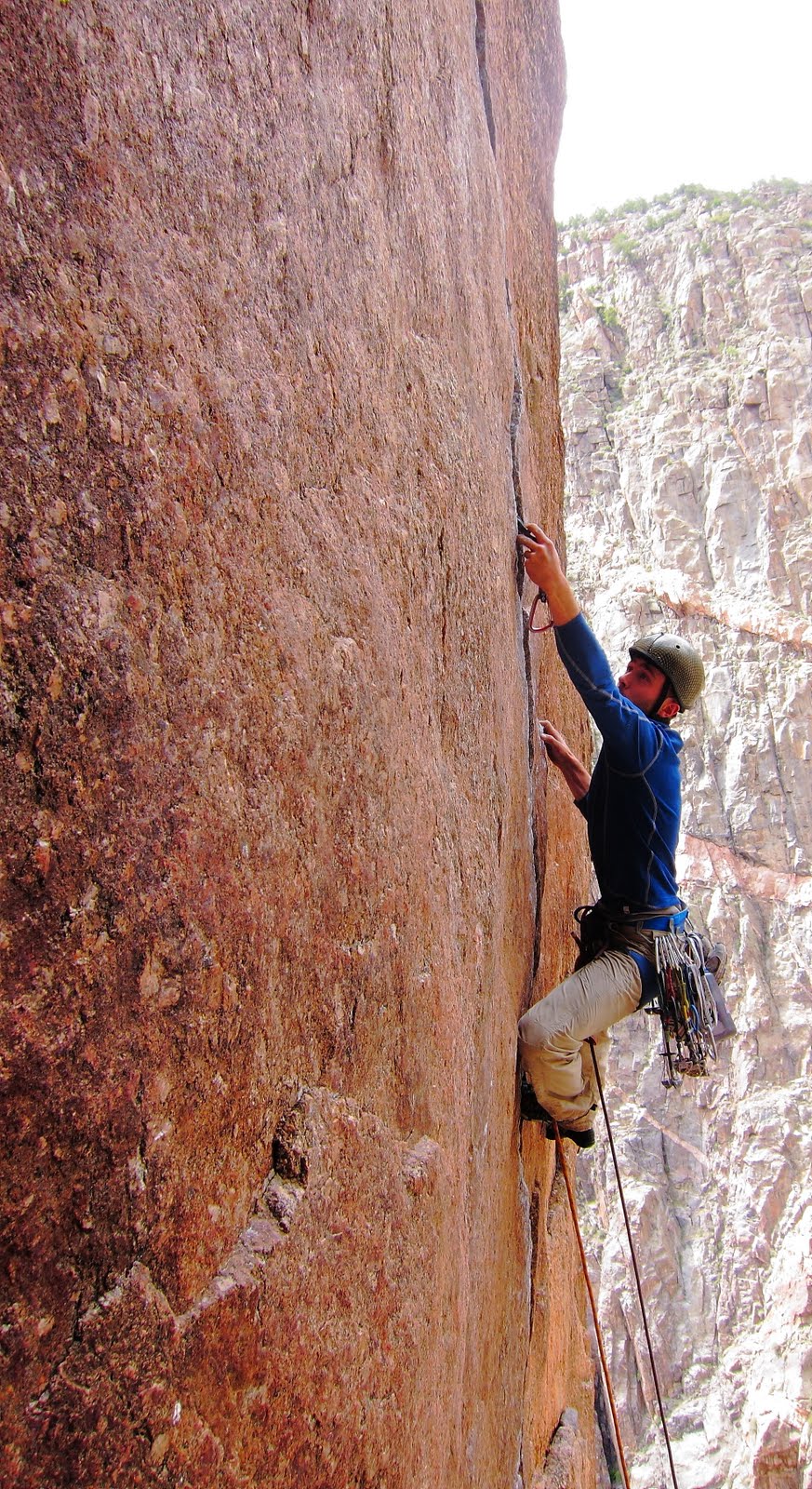


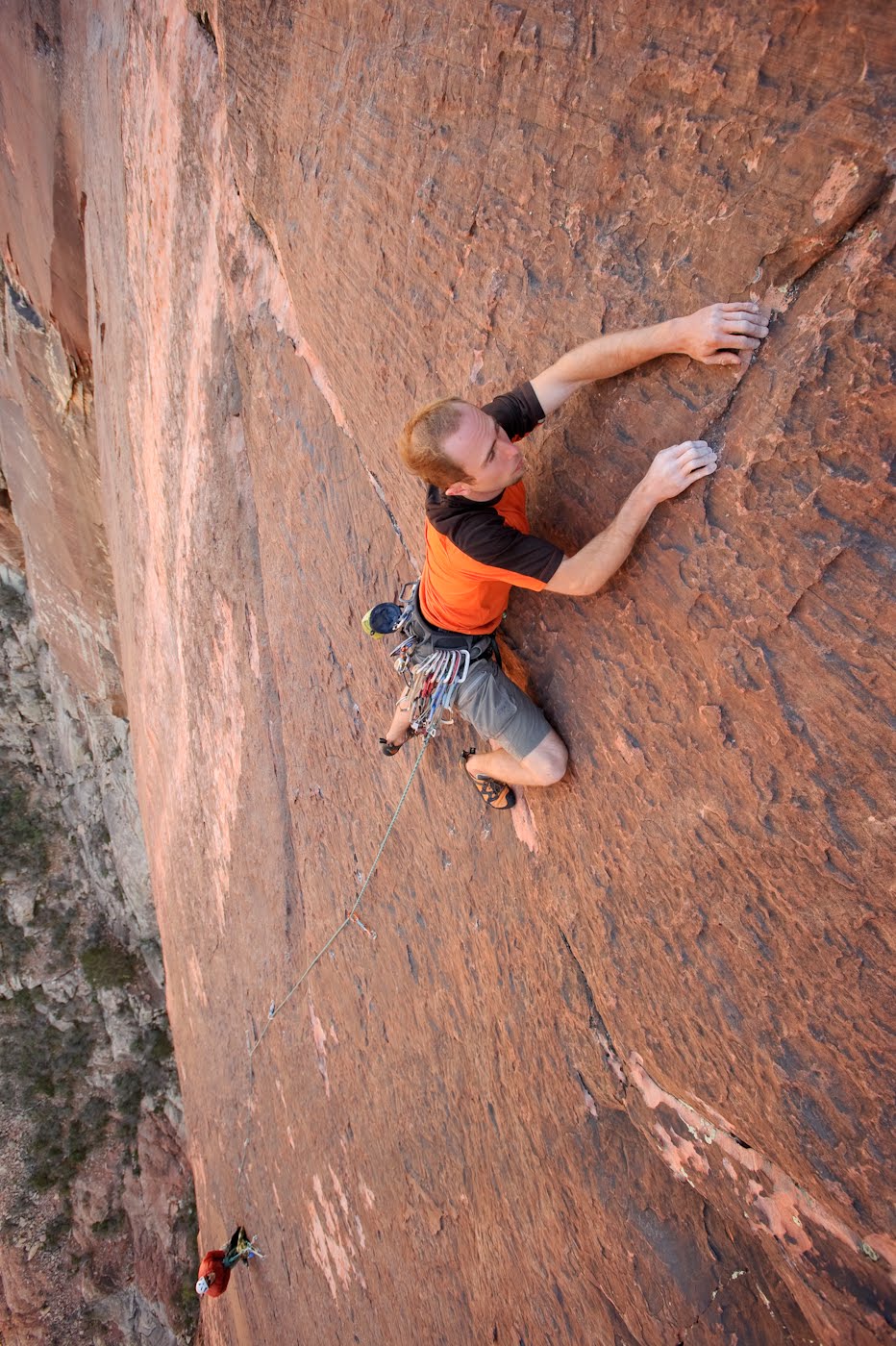
Finally, we hooked up with my friend Neil Kauffman from Patagonia for the climb "Escape Artist". Nate led the middle of the climb in one 280' pitch, so we did the route in 4 pitches with some scrambling afterward.

Last pitch on Escape Artist

5.20.2010

Drifting Away...


Glancing through Red Rock’s newest guidebook, one notices first ascent information from the 1970s, but few similar details for the park’s newest classics. Officially “anonymous” first ascents are now the norm. And we were keen to learn if these secrecy-inspired shenanigans were worth the trouble. A towering fin of white stone separates the Pine Creek and Juniper Creek drainages. Jason Killgore, Scott Bennett, Garrett Grove and I walked the crest single-file, comparing echoes down either side, and staring ahead at the Jet Stream Wall. Lacking the requisite skill, ambition, and four #00 TCUs for the sandbagged crux of Jet Stream (600’ 5.12c, AKA .13- "abstract stemming"), we set sights on Drifting (500’ 5.11c), a plumb line of patina edges, discontinuous seams, and illegally-drilled bolts.

Intricate face climbing and thin cracks typify the climb, and the easiest pitch of the route is an .11a which surmounts the wall's unmistakable arching roof. But it's not all "clipping bolts on the beach." Bring your gear skills for this one, especially on pitch #2, where an off-the-bat .11c crux leads to 120 feet of continuously intricate cracks, thin seams, and heady traverses. Unlike Levitation 29, Time’s Up, and older nearby routes, topping out on Drifting wont leave the bittersweet taste of bolted cracks in your mouth.


Pics Copyright Garrett Grove

5.14.2010

Life On The Wide Side

Our fifth day in Red Rock was the first without a recurring fight for the shared belay jacket. I'd brought two pairs of shorts and one pair of pants on the trip. Pride, if not prudence, demanded I implement the unusued 2/3 of my wardrobe. But what was worn as a great choice for the morning's two-hour hike becomes a recipe for disaster.


Photo: Garrett Grove. Don't Steal

I'm on deck to lead the last pitch of Adventure Punks (5.10d, 600'). The route's crux looms overhead. And it's knee-scrapingly, ankle-gougingly wide. I'm always nervous about the ".d" grades, especially on routes like this one. The 'Adventure Punks' were a loose-knit cadre of 1980s hardmen who eschewed bolts in favor of a traditional ground-up style. This attitude contradicted the era's prevailing 'route construction' philosophy, but also lead to some of the park's best and hardest climbs. And as I rack up to lead, I recall how it was the crux offwdith on the group's signature route which nearly put an end to the Adventure Punks.

Richard Harrison had sent the the route's finale with a hip belay from partner Nick Nordblom, one #4 friend, and an apparently more-than-adequate set of brass nuts. Sixty feet of serious 5.10 separated Harrison's stance atop the route from his #4. And when following the pitch, the swami-clad Nick Nordblom violated one of the Adventure Punks' rules. He fell. With no other gear in the pitch, Nordblom pendulumed across wall. The shouts from both climbers filled Pine Creek Canyon and were joined by the metallic "PING" of metal coming undone. Harrison was pulled onto a piton the piton was pulled from the anchor, and both climbers were suddenly dangling from a single 1/4" Rawl which the bolt-shy Harrison had begrudgingly placed.

With courage derived from the presence of cams unavailable to the Adventure Punks, I squirm, squeeze, and chimney my way upwards and into the slot. Moving my chalkbag and #6 out onto my left hip, I walk up my #5 camalot and imagine the scene 27 years prior. Harrison, facing the same squeeze, adjusts his swami until his knot is to the side, places his #4 friend, and begins his epic and unknown runout. I place my big cams, clip the 2 retro-bolts, and finish off the lead. I'm able to claim success, if not exactly style. But hey, Harrison’s rack was a whole lot lighter than mine was. And he was probably wearing pants too.

5.12.2010

The Meaningless "R"

It SNOWED in Denver yesterday (middle of May, mind you...) so I'll blame my purely-critical bloggery on the gloomy mood outside. Perusing the internet this afternoon, I came across a link to Hazel Findlay making the first female climb of Air Sweden in Indian Creek. And that's awesome. Air sweden follows a thin-hand and ringlock crack (Sweden-Ringle 5.12), then where the crack temporarily peters out (and Swedin-Ringle ends), one must use the incipent crack features and the nearby arete to continue straight up for ~3 body lengths without gear, until the crack reopens. This crack is then followed shortly to a second bolted anchor.

My problem? Air Sweden is "5.13 R"

I've always understood an "R" to mean that a fall is likely to result in injury. Hence in all but the most unusual of mountain circumstances*, I think adding an "R" is completely redundant when grading an alpine route, as very few don't feature some "fall and you're gonna get hurt" climbing.

Being above one's gear on a vertical or overhanging pitch is one thing, but climbing above one's gear with a strong likelihood of serious inury from a fall? That's something else. And it's something I generally seek to avoid. I don't want to just guess if that "R" stands for "rescue & evac." or "really clean airtime."


"I fell slapping quite high in the slot on my
second attempt, but it is a nice clean fall."


Dozens of climbers have been on Air Sweden, many of them falling repeatedly on film. (And here and here...) but not a scratch among them. It's not a dangerous route, and it shouldn't be "R" rated.

*an example of when I understand giving your alpine route an "R" rating is when falling from the route's crux, especially if it is several grades harder than anything else, would result in injury. A 5.11+ R with sketchy 5.9 and a well-protected 5.11 is different than a 5.11+ R where missing the crux onsight lands you in the hospital.

5.11.2010

Knowing it all...


A couple years ago, my friend Brandon Workman and I climbed Index's Upper Town Wall via the 5-pitch sport climb called The Golden Road. A new route, the first pitch featured bolts next to a crack, with every other pitch being bolted face climbing. The first pitch also seeps water long after the upper pitches dry out, and it's not unusual to pull on bolts or a cam to get through the p1 wetness. That's what Brandon and I did, which had me remarking that the bolts on this pitch weren't even needed. I knew cracks shouldn't be bolted, and that-was-that. I mentioned it to a couple friends at the time.

And I was way wrong. Those bolts were placed to prevent folks from having to use the crack, which ran along the left-side of a solid-looking, but fully-detached block. A week ago, the Index guidebook author and climbing partner levered the whole block off the wall, while aiding through that section on a #3 friend. This is the exact same thing
Brandon and I had done, and with gear in the very same crack that I said should make those bolt unnecessary. Maybe the first ascentionist, someone who'd climbed at index for years and spent hours on the route, did actually know the rock a little better than a 21-year-old kid who did the climb one time. It's a good reminder...


There are few people who are more often in the wrong than those who cannot endure to be so.
Francois De La Rochefoucauld

5.07.2010

You go Looking for an Adventure...


And you might just find one.

First Creek Canyon. Lady Luck reaches the dark band, Celtic Cracks is above.

One of our climbs in Red Rock proved to be obscure for reasons beyond the long approach and byzantine descent. It was also among the most memorable.

In an effort to try a few 'modern-moderates', Garrett, myself, and Rad Roberts hiked into First Creek Canyon, aiming for the 1000' slab climb called Lady Luck, and planning to link that into the 1000'+ Celtic Cracks on the Labyrinth Wall, which looms above the slabs.

For this day, our third in the canyons, the wind never gusted above 40MPH, a welcome change from the tempestuous chaos of prior outings. In fact, we all thoroughly enjoyed the calm on our first 7 pitches, lulled into a sense of complacency by the mellow climbing, solid stone, and sunny weather on the enjoyable Lady Luck.

While we snacked on a ledge, dark clouds flew in over Mt. Wilson, reminding us that Spring in the desert does not reward complacency.


By the time Rad lead the first pitch off the ledge, a steady mix of snow and hail covered positive handholds and ran down the cracks.By pitches 3 and 4, more than frozen precip would be falling.


Pitch3 of Celtic Cracks follows a left-arcing corner, which becomes a roof on the route's signature pitch. Unfortunately, this roof pitch sheltered us from falling snow only to shower us with falling dirt, gravel, flakes, and climbers.


Garrett knocks debris at Rad, scores several hits

Above this pitch, a short vertical sandbox brought us to a 600' offwidth and chimney crack. Snow continued to spit on us as for the 3 final pitches, where multiple 40' runouts, questionable flakes, and some stretches of suprisingly OK climbing crested the wall.

Bushwack canyoneering down a complex network of gulleys and rappel points provided ample time for contests like "what plant is poking me now?" and "who's got the most thorns in their boxers." Reaching our backpacks at Headlamp:30, we crowned Red Rock wildnerness as the day's only winner.

5.04.2010

Making it Happen

Today was the 7th consectuive day of climbing in the most remote parts of Red Rocks. Lots of 12+ hour days and amazing routes. We haven't shared a route with another party yet, and usually have our entire wall (or canyon!) to ourselves.

Here's Scott Bennett sending the roof on "The Breathing Stone"...


See the B&W photo below for the perspective on the pitch. I'd lead as well, with Garrett Grove following for the top-down photos of Scotty sending...

Lots more cool videos, stories, and photos of our 70+ pitches to come later.

4.26.2010

Perfect Pitch


The coach of my crew team in high school had a big impact on my life as an athlete and as a person. Whenever I can't summon up the motivation for an alpine start or trip to the gym, I remember Bill and become re-inspired. One of his (numerous) wise sayings, is that "The perfect stroke has never been taken." In a 2-kilometer race, we'd take over 200 strokes, so knowing that each one of these could be improved was something that stuck in the mind of an impressionable 16-year-old.

And I think the principal applies to much of our lives. Has the 'Perfect Pitch' ever been climbed?

Dave Evans on the first (and likely one of the few) ascents of the Breathing Stone - Western Spaces Wall

I'm off this evening for an 11-day trip to Red Rock National Conservation Area. On the "to-do" list is a freeclimb of the well-known Rainbow Wall, and an additional dozen routes that we're hoping most climbers haven't done, or haven't even heard of.

The Breathing Stone, Line of Addiction, Enterprise, and Ancient Futures... these are just a few of the long, difficult(for me), and potentially excellent routes that lie hidden on the park's lesser-visited walls. But with a long list of climbs, mostly following a 1-3hr approaches, this will be a good test of my fitness and ability to climb hard day-after-day. With the RPs, offset nuts, screamers, and lots of extra tat packed away, I'm ready to have an adventure! And to have the energy and psyche to punch it through that runout on day 9 and pitch 100, I just need to work on climbing some perfect pitches. Starting tomorrow...

4.13.2010

Mountain Climbing

I was recently asked by someone I'd just met "What kind of climbing do you like to do?"

I didn't have a very good answer. Or rather, I didn't have a very good way of saying my answer. I responded that I mostly enjoyed "mountain climbing" and left it at that, probably a pretty vague and unsatisfactory answer to what seemed a straightforward question. But I came across a quote from John Muir today that would have been a more apt description of why I most enjoy heading for an adventure in the alpine.

Thousands of nerve-shaken, over-civilized people are beginning to find out that going to the mountains is going home, that wilderness is a necessity, and that wilderness parks and reservations are useful not only as fountains of timber and irrigating rivers, but as fountains of life.

Of course, if I'd answered with all of that, I'd really have gotten an odd look.


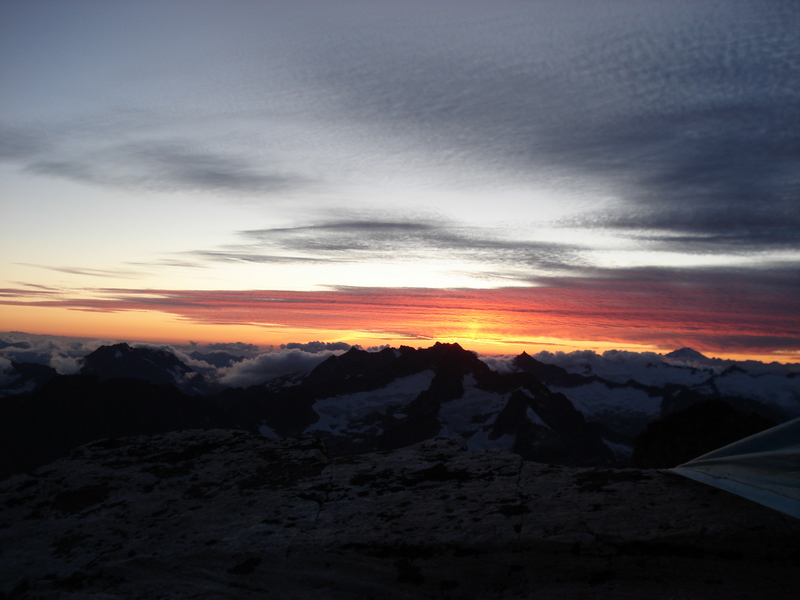
Sunset bivy from the highest point in the North Cascades National Park, after 2 days of mountain climbing with my friend Sol Wertkin. We were "living the dream" before the 20-something mile return to the road the next day.

4.07.2010

Neat Old Junk


Climbing a route, any route, allows the modern-day alpinist to compare his or her ascent to the prior ascents of a given peak. And for a history nerd such as myself, it's compelling to think about the same climb being done with the different technologies and techniques of past years or past generations.

Through an inability to stay on route, and the intentional desire to wander off the beaten path, I've come across an interesting array of climbing relics. Some of these I picked up in the North Cascades (old pitons in the Gunsight Range, probably from Fred Beckey's 1940 or 1967 trip) and others from Patagonia, New Zealand, or the desert Southwest.

Here are a few of the random little trinkets I've held on to:

Carabiner with no strength rating, UIAA certification, or any of that modern mumbo-jumbo. This was probably the precursor to the European brand Simond.

"Claudius Simond Chamonix"

Pitons from one of three trips to the Gunsight Range in the North Cascades. Dan Hilden and I thought our packs were heavy when we had to contend with hundreds of blown-down fir trees on the trail portion of the approach. I can't imagine doing the same trip with canvas rucksacks full of iron pitons.

Fred's AAJ entry from this second expedition to the range is so good, I have to include part of it here:

Four of us lost almost a day in just getting across the south fork of Agnes Creek, finally climbing a slippery log in a thundering canyon with the aid of about six
pitons. We then set up a tyrolean traverse from trees at a different location
for hauling packs and for the return trip out. In between these
exasperating episodes I was chased by a black bear. TO make matters
even more hectic,...


A Chouinard Hex. Moss has grown over the knot, but the part of the cord that was not exposed to sun still seems pretty strong. This came from an ascent of "The Passenger" last summer, on South Early Winter Spire.


Original flat-sided Chouinard #4 "Stopper"


And the most recent addition, a #6 "Titon" which was something invented by Kris Walker and Bill Forest. Perhaps the little tree with a "W" stands for "Forrest/Walker"? This was found on the route Jupiter II in Red Rock, along with a straight-sided stopper, stamped with the initials VB (likely for prolific Red Rock climber Paul VanBetten).

This Titon says PH on it, but I've got no clue who that is. I'm glad we're not all pounding our initials into our gear these days...