8.28.2013

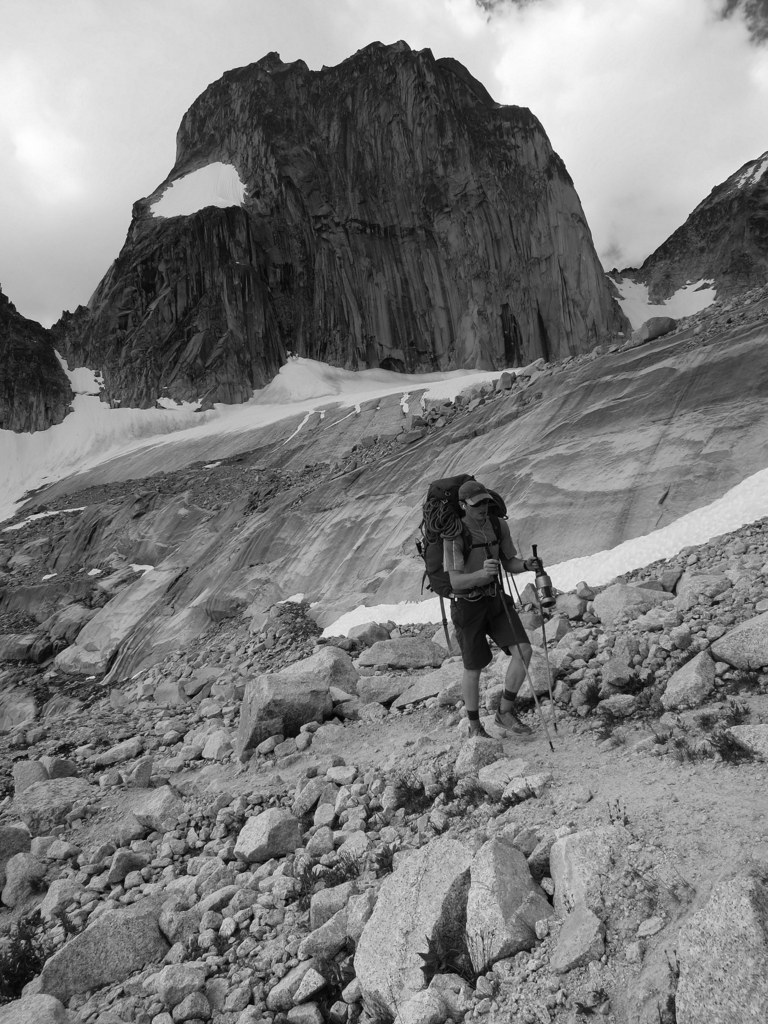
Mt. Bute - West Face Free & Coast Range Adventures


'86 Foweraker-Serl 5.10 A2 
 '13 Herrington-Sorkin 5.12-
The Coast Mountains of British Columbia hold many of North America's most spectacular granite walls and peaks, and are often ignored by alpinists heading (farther) north into Southeast or South-Central Alaska. These peaks are hard and expensive to reach, and seldom very glamorous. I first became aware of one of the range's outstanding peaks, Mt. Bute, several years ago, when a team of three climbers from Squamish won a Mugs Stump Grant to travel there, then succeeded in establishing a monstrous ridge climb gaining roughly 6,000 (School of Rock 2009 Martinello-Kay-Sinnes 5.11 A2). The trio describe Bute's West Face in their Mugs Stump report as "certainly one of the finest pure rock features in the Coast Range; it deserves a free ascent."  


8.27.2013

Bugaboos Pictures


In July I made my first trip to BC's Bugaboo Provincial Park with old friend Nate Farr. We didn't venture onto the Howser Towers or the more remote East Creek Basin, as nearly every day's weather called for some amount of precip. I was impressed with how well-organized and managed the scene at Applebee Campground has become, thanks mostly to BC parks' upkeep and climbers' good wilderness practices. The camping had spots to hang food, metal lockers, posted weather forecasts, well-kept outhouses, and easy access to the big East Face of Snowpatch Spire and the South Face of Bugaboo Spire. For climbs on these features, you only need tennis shoes and a light axe or trekking poles. I never put on my crampons. If you are only doing routes that you'll rappel, bringing big clunky boots will keep your feet dry, but will obviously be a pain-in-the-arch for the steep 3hr hike in.

7.08.2013

Stuart Range Quadruple Header

The immaculate West Face of Colchuck Balanced Rock - climb #1 of the day.
Garrett Grove Photo

I always try a big car-to-car day around the time of the summer solstice, and this year I lured my friend Max Tepfer to come up from central Oregon and join me for a 4-climb linkup in the Stuart Range, close to my home in Leavenworth.

Max is a Smith Rock and Trout Creek crusher who stays in cardio shape guding clients around the Oregon Volcanoes. He had 1 day off work between guiding at Smith, so he was psyched to try for a big crazy day. He was literally in the area for 30 hours, 22 of which were spent climbing. He commuted 6 hours each way to make the day happen, and was onsighting nearly every route.

6.05.2013

Washington Pass Freedom

I've made a couple early-season visits to Washington Pass this Spring, combining some skiing with climbs of some routes I hadn't done before. I was also able to team up with Graham Zimmerman to establish a new direct freeclimbing start to the left of the aid pitches on Mojo Rising, South Early Winter Spire.

5.30.2013

Sending the Seven Cs

Tom Moulin crushing Velvet Tongue.
Pic from Jerry Handren's excellent guidebook.
7c is the French/Spanish rock grade that translates to about 5.12d on the Yosemite system used in North America. About a year ago I invented a challenge for myself, which was to climb the classic "7c" long route in all of the great climbing areas of North America. The idea began as a discussion with a friend about all of the amazing routes in this grade range (give or take a letter) and the best part about inventing this goal myself, is that I can tweak things (within reason) to make sure that a stellar .13a or .12c is not ignored just because, strictly speaking, it is not one of the "7c"s. But more than just the individual pitches that make up these climbs, I want this ongoing challenge to focus on climbing partners and amazing areas I have yet to see. Ideally it will result in me seeing new ranges and parks (The Incredible Hulk, for example) and climbing more with a far-flung crew of partners.  I made progress this spring, with the Neo-Classic Red Rock climb Velvet Tongue in Black Velvet Canyon.

5.21.2013

Catalonia Climbing

Allison in Riglos
It really is THAT good in Catalonia.

But you probably already imagined as much, so here is some info that you may not have known.

Catalonia/Catalunya is a semi-autonomous region of NE Spain where business signs and streets signs feature their own spelling of common words, so don't assume you will understand everything just because you understand Spanish.

Barcelona is beautiful and VERY walkable, with a compact feel to the town, and numerous fun sights to keep your pedestrian days entertaining. On Sunday many of the museums and attractions are free but long lines develop - plan accordingly.
Cooking class in Barcelona

One of the many famous buildings designed by Gaudi - Casa Batlo


The crew gearing up in Riglos.
Numerous crags feature world-class lineups of walls and climbs. We hardly scratched the surface. We based out of the rental house of Greg Collum, hardman of alpine FAs around the world, and former local of Index, WA. His house is in the picturesque village of Cornudella de Montstant, a short drive from Siurana, Montsant, Arboli, Oliana, and Margalef. This area is best climbed from fall to spring, with the summer generally being too hot. One of my favorite routes in Siurana was called "Bistec de Biceps" - a .12c that was featured in the 1980s climbing movie "Masters of Stone IV."Overall Siurana is a bit like the Smith Rock of Spain, and old-school area with a well-deserved reputation for solid grades and real climbing.


Stolen pic of perhaps my favorite route of
the trip, Montsantrrat, a long .12c I onsighted at
the stellar Roca de La Misa Sector, Montsant.
After climbing and travelling in this area, our trip concluded with a 2-day visit to the "mallets" that comprise the famous area of Riglos. Riglos was charming and the routes were great as long as we were not climbing below other parties trundling rocks on us. Scott Bennett and I climbed the world's most enjoyable sport route, a famous line called "Fiesta de los Biceps, which was even more of a fiesta because it was pouring rain for much of the climb, yet only about the last 20 feet of the 800' climb are not overhanging and perma-dry. I lead the first two pitches (and the crux .11d thin move) and Scott lead the last two. We were originally planning on rappeling the route, but it is SO STEEPLY OVERHANGING that we opted for the rock-shoe walk off.

We ended our trip with a few days along the Atlantic coast/ French border in Basque country, where the new language, street signage, cuisine, and people all contributed to a feeling of having gone to a different country entirely. We didn't climb there, but good cragging and alpine adventures are rumored to exist, if you can make sense of the road signs and find the peaks and crags.

You can see two climbers following a chalk line on the large wall on the right,
that is Scott and I on Fiesta de los Biceps.
                               Dani Andrada's "Lleida Climbs" - areas around Tremp, Lleida, Terradets

  • Stay - In the Siurana area - free camping atop the cliffs in Siurana, or email Greg Collum about his rental house if you have a large group. There is also a climber hostel in Siurana. In Riglos, DEFINITELY stay with the couple who own the local restaurant/bar/climber-viewing hangout area called El Puro. The owner's name is Jose Ramon, his wife (forgot her name...) is from the Dominican Republic, and for 20EU you get a nice room, shower, and amazing home-cooked breakfast.
  • Getting there - Fly in and out of Barcelona and rent a car, or better yet, fly in and out of the the town of Reus, which is 40 mins SW of Barcelona. Many of the cheap Euro airlines' flights to/from Barcelona (RyanAir, for example) actually use the Reus airport, which is closer to the climbing and doesn't involve big-city headaches.

4.30.2013

Costa Blanca Climbing

Wild Side Wall at Sella
The second major area we visited in Spain was Costa Blanca, which is Spain's eastern inland coast. We were all amazed at the variety of climbing in the area, with excellent tufa-strewn overhangs and multi pitch formations with routes from 5-10 pitches.

The local "culture" along the coast itself is very non-Spanish, as many northern Euros come to the Costa Blanca every summer. This has had two nice results for climbers:

  1. There is a huge amount of empty lodging during fall, winter, and spring.
  2. There will likely be folks nearby who speak something other than Spanish, and who are used to lost visitors in need of help.
As long as you explore some of the towns, winery areas, valleys, etc just up off the coast, you can definitely be surrounded again by real Spanish culture.

The Magic Flute - Bernia
  • Climb- Multipitch bolted routes directly above the Mediterranean  Calpe's "Penon d'Ifach" is a  1000' limestone tower that looms above the sea, and hosts routes from 5.9 to 5.13. There is a casual walkoff complete with gatos de cumbre. Multipitch routes near the town of Guadalest and on the Pared de Rosalia look great as well. The best single-pitch zones we visited were Bernia (for Tufa Groove and it's inverse twin Magic flute) as well as Gandia (short climbs, but wild tufas down low) and the best crag in the region, the truly amazing Wild Side at Sella for climbs from 5.12- to 5.14.
  • Stay - We rented a super cheap apartment 2 blocks from the beach in Calpe. We could walk to the Penon D'Ifach and it was easy to drive to hundreds of nearby walls - Ours was $200/week and had one bedroom, one futon, and a kitchen. Other friends stayed in the small town of Finestrat, inland from the beach and near Sella.
  • Eat - Lots of the cafes and bakeries along the coast are more influenced by northern europe, even the grocery stores have loads of German, British, Scandanavian foods, etc.
  • Wild Wide Wall - Sella
      Drive
      - When in doubt, opt to take the AP-7 expressway over the alternative roads that are all much slower and wander through many slow towns.
    • Book - The brand new (Spring '13) Rockfax Guide to Costa Blanca is excellent.
    • Season- Any time except June-September, both because the area is much more crowded and expensive with summer tourists, and because it would be very hot. Certain walls (inland and North-facing) would be too cold or much of winter.


    4.21.2013

    Spain: Andalucia, El Chorro, and the South

    I just returned home to Leavenworth following 6 weeks in Spain. Rather than go into various details about all the 8a routes I didn't quite send, and the boring minutiae of describing an individual sport climb, I'll just provide some information that will help everyone else who is thinking of going there. Which should be everyone who climbs. Spain is amazing, and pretty cheap. Check out DoYouSpain for cheap car rentals.


    • El Chorro
    In mid-winter, and for climbers who wont have a car, El Chorro is a great place to go. It's located about 40mins (by car or by train) from Malaga, on the southern coast of Spain. We arrived via a ~5hr drive after renting a car in Madrid. There is a RENFE (Spain's rail system) station stop IN the tiny village of El Chorro, just a 5-20 minute walk from camping, hostels, and hundreds of pitches of limestone. Here are a few things to keep in mind about El Chorro.

    4.03.2013

    Seattle Times Feature Story

    I collaborated with friend and neighbor Garrett Grove for a story published on the front of last sunday's Seattle Times travel section about our home of Leavenworth, WA.

    Check out a copy of the paper for more of Garrett's photos, or read the entire story online here.


    3.31.2013

    Climbing Magazine - Better Ice Rappels

    I recently had an article published in Climbing Magazine about long ice rappels with minimal gear. Check out the piece and the comments posted online: