3.14.2014

Torres Del Paine


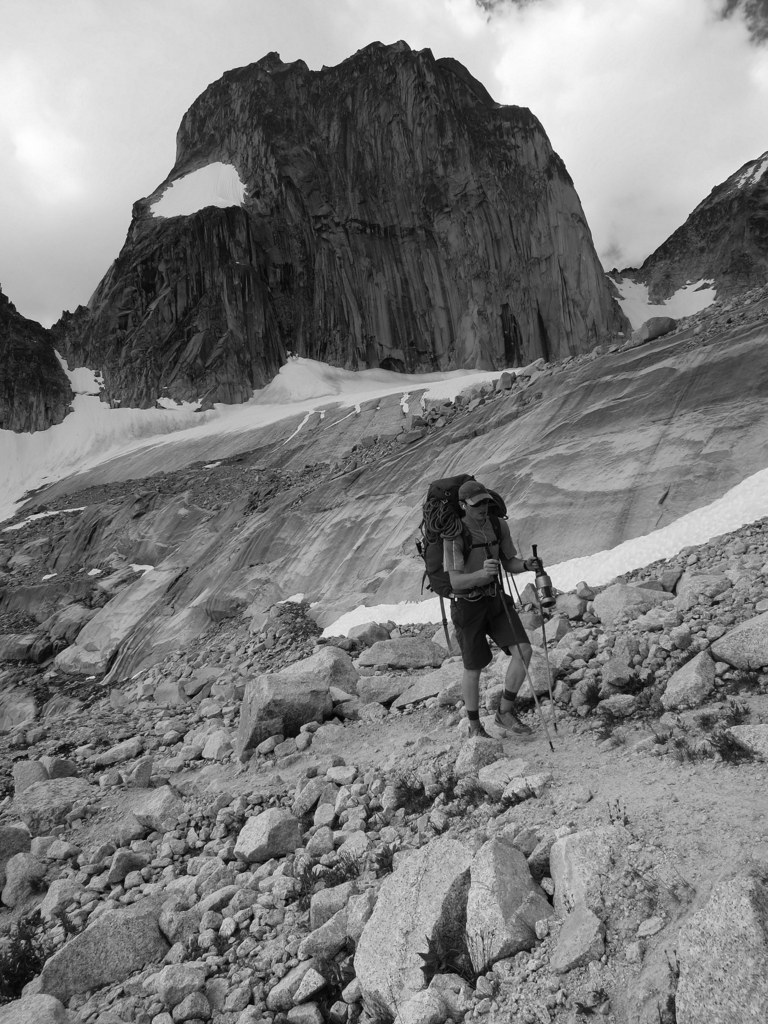
I spent most of January 2014 in the Torres Del Paine of Chilean Patagonia. It was my first time to this range of Patagonia, and the area has some of the world's most amazing peaks. The three "towers" (north, central, south) are well-known and famous, but the Paine also holds other amazing peaks that are not so visible from the trailhead. These mountains are only about 90 or 100 miles from the vastly more popular (among climbers) peaks of the Fitz Roy and Chalten ranges, so the weather is generally the same in both parks. (very bad) Unlike Fitz Roy and the nearby peaks, accessed by an ever-growing international crowd living in a booming city, the climbing in the Paine almost certainly requires an expedition-style approach, with a backcountry camp, or camps, and no quick access to the outside world.

I was climbing with Scott Bennett, and we had big plans to try and freeclimb routes on the west face of the central tower, such as Wild Wild West (Cosgrove-Smith) or Via Delle Mamme. Unfortunately, the longest decent weather span we had during three weeks was about a day, and things usually take at least that long simply to clear of the ice and snow that accumulates. It was cold and blustery, even snowing in our low camp on a couple of days. We ended up climbing a free variation to the "Vuelo Del Condor" ((Pennings-Tague) on the east wall of the Cuerno Este, but this rock climb, like many on the Cuernos, does not summit. Cuerno is Spanish for 'horn' and the cuernos are peaks which are topped by striking caps of (sometimes very overhanging) horrendously compact and friable shale. There is essentially no snow and ice or gully climbing in the Paine, just steep walls and towers. Unlike the climbing in the Chalten/Fitz Roy area, you can't really go swing tools and wear gloves and boots to climb in marginal days. It's rock climbing or no climbing at all, so the range is less forgiving during very bad weather.


We based out of a low camp in the highest stand of trees the Bader Valley, reached via a ~10-12 mile hike from the trailhead at the Hosteleria de los Torres. This was a remote and beautiful locale, but if you are ever headed to the Paine, we found that the rock quality and freeclimbing options in the Bader Valley, despite being in the center of the range, were generally sub-standard relative to the rock quality in either direction. We wanted to climb a super chossy line somewhere else, and name it "I can't believe it's not Bader." However, this is probably also the most sheltered valley in the Paine, so it could be a good option for very marginal weather windows. The head of this valley is glaciated and has a beautiful alpine lake and a dirty moraine lake, as well as easy access to the peak such as the Cuernos (Este, Principal, Norte) the Mascara, Hoja, Espada, and the South Tower of Paine.

Here are a few good points of beta for climbing in the area:


  • There is no grocery or supply seller anywhere near the park. Buy everything you need in Puerto Natales, and then take a bus to the park with your provisions. The bus ride is ~2hrs.
  • Apply online in advance for a free climbing permit at least a week before you go. You'll need proof of rescue insurance, such as with an AAC membership. 
  • As a climber, you will ride the bus PAST the park entrance, on to the official administration building, then enter and have the park officials sign off that you can go climbing, then re-board the bus, return to the park entrance, and then catch a bus transfer for the final ~15min ride to the trailhead/camping/Hosteria de los Torres. We never saw any rangers or were asked about our climbing gear, so we certainly could have gone without a permit, but if you were to encounter a ranger and not have one, they might turn you back. 
  • Depending on your base camp of choice and climbing area of choice, you may be wise to hire a pack horse (Pinchero) or a porter or to for load-carrying assistance. Most of the climbing is done from the French Valley (Cerro Catedral, Cota 2000, Aleta de Tiburon) or the Silencio Valley or Ascencio Valley (Torres Del Paine). 
  • For help arranging a porter, pack horse, navigating the park rules, or finding a place to stay in Puerto Natales, your best bet is to go see Cristian, the owner of Fortaleza Patagonia in Puerto Natales. He has climbed in the parked and seemingly knows everyone and everything important in the region. The company office is located in downtown Puerto Natales.

2.19.2014

The Unstoppable Smile

It was a gray Washington winter day, tromping around looking for frozen cascades that had survived the end of our week-long "ice season". Chad Kellogg, Jens Holsten and I had just climbed the two wettest pitches any one of us had done. I lead the easy first pitch, a slurpee beneath a waterfall to a cave with water pouring all around us and puddled at our feet. Chad probably pulled out both screws by just wiggly them out from the slush. Chad then stepped out of the cave on lead and we could hear the 33-degree water pounding onto his head from hundreds of feet above. We thought he would be able to step out from beneath the shower, but it covered the entire width of the ice flow so he just clawed his way up. Chad didn't bother shouting down to us, partly because if he'd open his mouth it would fill with ice water. Whenever he'd raise a tool, water would run down his arms inside his jacket, soaking him from the inside-out. 


Shivering in the cave, Jens even admitted that he could at least "understand why some people don't like ice climbing." 

When Jens and I reached a soaking-wet Chad after he'd been standing immobile at the belay for the past 10 minutes, his smile was ear-to-ear and there was nowhere you could imagine him rather being.


12.16.2013

Fall is for Sending, Not Falling


As usual, fall has provided a great mix of climbing
opportunities in Leavenworth and around the northwest, with everything from excellent roped rock climbing to bouldering and skiing along with waterfall ice. I took a quick visit to the sandstone and limestone of Mt. Charleston and Red Rock, NV, doing some short sport climbing, a 4-person party ascent of Epinephrine, and a ego-deflating non send of Texas Tower Direct. I also made a few short trips to central Oregon, where the amazing walls of Trout Creek and Smith Rock beckoned. At the American Alpine Club Craggin' Classic, I teamed up with Ben Rueck for the 10-hour "Crushfest" climbing competition. We came in second place, having onsighted and redpointed 67 pitches along the front side at Smith, an even mix of sport and trad routes.

At Trout Creek I "succeeded" in linking all the moves and cleanly TRing the open project left of Gateway. This line is going to be the hardest thing yet at the wall, with a couple boulder problems requiring some serious power and steel finger tips. It will be well protected with small cams and RPs. Trout's at-one-point hardest route, May Fly, put up by my friend Cody Scarpella and repeated by Tommy Caldwell, was repeated this fall by myself, Max Tepfer, and impressively flashed by Mikey Schaefer. It takes a narrowing 5.11/5.12 finger crack which ends at the same height that a nearby finger crack begins, requiring a ~V4 crux and amazing lower 5.11 climbing to the chains. Check out Cody working (and whipping) before the FA (starts at 3:40).


An hour west across the pass from Leavenworth, in Index, a couple days of climbing and working out beta with Jens Holsten and Ben Gilkison resulted in redpointing Narrow Arrow Direct, a gymnastic 5.12c pitch with the crux just below the ledge atop the pitch. I'd like to send every pitch on the "Narrow Arrow" by next spring, and now I've done the two (by far) most difficult lines.

The bouldering this fall was also excellent, with many pleasant, dry, but mid-temperature sunny days. I continued to fall off what might be the closest boulder problem to my house, "Fridge Left" (V8).  But I did manage to complete the classic "WAS" (V8) on my first visit to the problem with a big rowdy crew of locals.

Late fall saw a big early snowfall and then a prolonged clear cold snap. I teamed up with old buddy Kurt Hicks and his friend Dustin to climb the rarely-in-condition Drury Falls above Leavenworth. Drury is one of the iconic ice climbs of the northwest, with an often-dangerous approach, a mandatory river crossing, and a little less than 1,000' of water ice. The early cold stretch with low snow made the approach perfect, and we avoided the sketchy rapids and pre-dawn boat shenanigans by simply rowing across Lake Jolanda below the whitewater, then hiking the opposite bank. The descent is generally mellow and made via tree rappels to the left of the route.
There are 2 ~55m approach pitches below, out of view.


Finally, I headed out to the Entiat Valley for some obscure local ice with Chad "(peak)crusher" Kellogg and Jens "(grape)crusher" Holsten. There are AT LEAST  twice as many major flows which form up during a cold snap than you would expect from the guidebook. Jens sent the WI5 column "What do Ardenvoirs Eat?" and we then ramblied up the CLASSIC second pitch (much easier). To end the day Chad and I lead the 2-pitch "Tyee Falls" - which was similar to climbing slushy snice beneath the gutter of a house, the only difference being that one could not simply traverse or move out from beneath this gutter, because it was the entire route (except the classy cave belay).


10.29.2013

Spain Story - Climbing Magazine

I had a story published in the October 2013 issue of Climbing Magazine about a trip last Feb/March to Spain.  Here is a snippet, the entire article has now been posted online by Climbing Magazine.


8.28.2013

Mt. Bute - West Face Free & Coast Range Adventures


'86 Foweraker-Serl 5.10 A2 
 '13 Herrington-Sorkin 5.12-
The Coast Mountains of British Columbia hold many of North America's most spectacular granite walls and peaks, and are often ignored by alpinists heading (farther) north into Southeast or South-Central Alaska. These peaks are hard and expensive to reach, and seldom very glamorous. I first became aware of one of the range's outstanding peaks, Mt. Bute, several years ago, when a team of three climbers from Squamish won a Mugs Stump Grant to travel there, then succeeded in establishing a monstrous ridge climb gaining roughly 6,000 (School of Rock 2009 Martinello-Kay-Sinnes 5.11 A2). The trio describe Bute's West Face in their Mugs Stump report as "certainly one of the finest pure rock features in the Coast Range; it deserves a free ascent."  


8.27.2013

Bugaboos Pictures


In July I made my first trip to BC's Bugaboo Provincial Park with old friend Nate Farr. We didn't venture onto the Howser Towers or the more remote East Creek Basin, as nearly every day's weather called for some amount of precip. I was impressed with how well-organized and managed the scene at Applebee Campground has become, thanks mostly to BC parks' upkeep and climbers' good wilderness practices. The camping had spots to hang food, metal lockers, posted weather forecasts, well-kept outhouses, and easy access to the big East Face of Snowpatch Spire and the South Face of Bugaboo Spire. For climbs on these features, you only need tennis shoes and a light axe or trekking poles. I never put on my crampons. If you are only doing routes that you'll rappel, bringing big clunky boots will keep your feet dry, but will obviously be a pain-in-the-arch for the steep 3hr hike in.

7.08.2013

Stuart Range Quadruple Header

The immaculate West Face of Colchuck Balanced Rock - climb #1 of the day.
Garrett Grove Photo

I always try a big car-to-car day around the time of the summer solstice, and this year I lured my friend Max Tepfer to come up from central Oregon and join me for a 4-climb linkup in the Stuart Range, close to my home in Leavenworth.

Max is a Smith Rock and Trout Creek crusher who stays in cardio shape guding clients around the Oregon Volcanoes. He had 1 day off work between guiding at Smith, so he was psyched to try for a big crazy day. He was literally in the area for 30 hours, 22 of which were spent climbing. He commuted 6 hours each way to make the day happen, and was onsighting nearly every route.

6.05.2013

Washington Pass Freedom

I've made a couple early-season visits to Washington Pass this Spring, combining some skiing with climbs of some routes I hadn't done before. I was also able to team up with Graham Zimmerman to establish a new direct freeclimbing start to the left of the aid pitches on Mojo Rising, South Early Winter Spire.

5.30.2013

Sending the Seven Cs

Tom Moulin crushing Velvet Tongue.
Pic from Jerry Handren's excellent guidebook.
7c is the French/Spanish rock grade that translates to about 5.12d on the Yosemite system used in North America. About a year ago I invented a challenge for myself, which was to climb the classic "7c" long route in all of the great climbing areas of North America. The idea began as a discussion with a friend about all of the amazing routes in this grade range (give or take a letter) and the best part about inventing this goal myself, is that I can tweak things (within reason) to make sure that a stellar .13a or .12c is not ignored just because, strictly speaking, it is not one of the "7c"s. But more than just the individual pitches that make up these climbs, I want this ongoing challenge to focus on climbing partners and amazing areas I have yet to see. Ideally it will result in me seeing new ranges and parks (The Incredible Hulk, for example) and climbing more with a far-flung crew of partners.  I made progress this spring, with the Neo-Classic Red Rock climb Velvet Tongue in Black Velvet Canyon.

5.21.2013

Catalonia Climbing

Allison in Riglos
It really is THAT good in Catalonia.

But you probably already imagined as much, so here is some info that you may not have known.

Catalonia/Catalunya is a semi-autonomous region of NE Spain where business signs and streets signs feature their own spelling of common words, so don't assume you will understand everything just because you understand Spanish.

Barcelona is beautiful and VERY walkable, with a compact feel to the town, and numerous fun sights to keep your pedestrian days entertaining. On Sunday many of the museums and attractions are free but long lines develop - plan accordingly.
Cooking class in Barcelona

One of the many famous buildings designed by Gaudi - Casa Batlo


The crew gearing up in Riglos.
Numerous crags feature world-class lineups of walls and climbs. We hardly scratched the surface. We based out of the rental house of Greg Collum, hardman of alpine FAs around the world, and former local of Index, WA. His house is in the picturesque village of Cornudella de Montstant, a short drive from Siurana, Montsant, Arboli, Oliana, and Margalef. This area is best climbed from fall to spring, with the summer generally being too hot. One of my favorite routes in Siurana was called "Bistec de Biceps" - a .12c that was featured in the 1980s climbing movie "Masters of Stone IV."Overall Siurana is a bit like the Smith Rock of Spain, and old-school area with a well-deserved reputation for solid grades and real climbing.


Stolen pic of perhaps my favorite route of
the trip, Montsantrrat, a long .12c I onsighted at
the stellar Roca de La Misa Sector, Montsant.
After climbing and travelling in this area, our trip concluded with a 2-day visit to the "mallets" that comprise the famous area of Riglos. Riglos was charming and the routes were great as long as we were not climbing below other parties trundling rocks on us. Scott Bennett and I climbed the world's most enjoyable sport route, a famous line called "Fiesta de los Biceps, which was even more of a fiesta because it was pouring rain for much of the climb, yet only about the last 20 feet of the 800' climb are not overhanging and perma-dry. I lead the first two pitches (and the crux .11d thin move) and Scott lead the last two. We were originally planning on rappeling the route, but it is SO STEEPLY OVERHANGING that we opted for the rock-shoe walk off.

We ended our trip with a few days along the Atlantic coast/ French border in Basque country, where the new language, street signage, cuisine, and people all contributed to a feeling of having gone to a different country entirely. We didn't climb there, but good cragging and alpine adventures are rumored to exist, if you can make sense of the road signs and find the peaks and crags.

You can see two climbers following a chalk line on the large wall on the right,
that is Scott and I on Fiesta de los Biceps.
                               Dani Andrada's "Lleida Climbs" - areas around Tremp, Lleida, Terradets

  • Stay - In the Siurana area - free camping atop the cliffs in Siurana, or email Greg Collum about his rental house if you have a large group. There is also a climber hostel in Siurana. In Riglos, DEFINITELY stay with the couple who own the local restaurant/bar/climber-viewing hangout area called El Puro. The owner's name is Jose Ramon, his wife (forgot her name...) is from the Dominican Republic, and for 20EU you get a nice room, shower, and amazing home-cooked breakfast.
  • Getting there - Fly in and out of Barcelona and rent a car, or better yet, fly in and out of the the town of Reus, which is 40 mins SW of Barcelona. Many of the cheap Euro airlines' flights to/from Barcelona (RyanAir, for example) actually use the Reus airport, which is closer to the climbing and doesn't involve big-city headaches.