With some ski boots (liners) baking in my oven alongside a batch of muffins, I am wondering if my boots will smell like pumpkin or my muffins will taste like boot? Either way, I am getting excited for some skiing!
I have an idea for a multi-sport 'Rado outdoors day, involving biking, fly fishing, rock climbing, ice climbing, mountain skiing, and XC skiing, all in one day. Potentially with no car between activities. It could be doable in Clear Creek Canyon, ten miles from my house. If I do it, it will be on my trusty Alpine Touring Skis. I chose A/T skis over Telemark skis because the setup is more climber-friendly and easier to learn, but I do have a twinge of jealousy when I see a really smooth and graceful Tele skier heading down the hill. On that note, here is a HILLARIOUS video expressing some of those same sentiments. The music starting at 1:38 goes out to a certain friend. Enjoy Bro!
Actually, they are both basically commodities. Homogeneous, interchangeable products with little difference between the item from one apple orchard (or rope weaver) to the next. Anyone who tells you that a certain climbing rope is "the best" or far superior (or inferior) to others is probably obligated to have that viewpoint by dint of employment for a rope company, or free ropes provided by a given company. And as ropes are both expensive and expendable, they make up a pretty significant cost for climbers.
The veteran climbers I know think a rope is a rope is a rope. Determine what length and width you want, and buy the cheapest one you can find. Has there ever been a route or peak that was climbed because the rope was a 9.4mm Bluewater, not a 9.4mm PMI? Sure Chris sent with a Sterling, and said it made a difference, but I have my doubts. One could make the same case about jackets, gloves, carabiners, etc but the difference among equally-sized ropes is far less than any other type of equipment. I've used ropes from just about all the mainstream manufacturers, and can't really notice any overall differences in handling or durability. If the labels were removed and I was belaying blindly, I have NO confidence that I would be able to tell one from the other or would consistently prefer the ropes of a single manufacturer. And just like I've never had one fuji apple that was much worse (or better) than any other, I've never used a 10.2mm climbing rope that felt, or lasted, much differently than the others. Do all these companies use the same rope-weaving machines in the first place?
Ignoring brands is not to say that different rope types don't matter. If I'm eating a snack and want to cover my apple slices in peanut butter, I'm going to choose a different type of apple than I would for making a pie. In this way, I'd choose a different length and width of rope (or different rope system) for a climb depending on its length, ice vs rock, descent, number of climbers, approach, etc. But once I settle on which length and width I'll need, I'm basically interested in price.
There are a few other small differences, but none which I think are worth paying a whole lot more for:
Dry coatings are somewhat helpful, but don't bother paying for one if just using your rope for rock climbing during nice weather. That's probably 90% of users. Likewise, no dry coating is going to keep your rope from getting saturated in this kind of rappel.
Light-colored ropes show up well in photos and maintain a sharper contrast to their middle mark.
Middle marks are very useful. But if that on-sale rope doesn't have one, then use a sharpie or sew dental floss through the sheath rather than paying an extra $20.
Bi-Pattern ropes (changing color at the halfway point) are handy if you want to tie into both ends and use a single rope with half-rope technique, however...
Finding the middle point (color change location) on a Bi-Pattern rope piled on a belay ledge or rope tarp is a huge pain, and actually takes way longer than finding the middle point when this spot is marked on a one-pattern rope.
If you're about to make multiple rappels on a rope with a bad middle mark, grab a band-aid, a piece of tape, or some chalk, and mark the middle. These will last through a surprising number of rappels.
Metolius/Monster ropes sew two pieces of orange floss through the rope's middle, and one 10m from each end. You can see and feel these. Smart...
Some folks want a low impact force in order to minimize the potential for marginal gear pulling from the rock/ice. I've never paid much attention to these, maybe just because I'm not brave enough to climb routes with high fall-factor potential on very dicey gear. If in these situations, I think using a screamer and having an attentive/dynamic belayer would help just as much as using a rope with a lower impact force.
I'm curious if anyone really does think certain ropes brands are better or worse than others. As for now, I'll stick with whatever is on sale. And remember, the best rope to use is always your partner's. Happy rope buying!
Sunny days and quick approaches. This is winter in the 'rado.
I've had a great few days around Denver, enjoying rock and ice climbing, and starting work at an Italian restaurant only 7 blocks from home.
Last week I teamed up with Justin Selmanson who works at Trango, and we climbed "The Naked Edge" in Eldorado Canyon.
The route follows the sun/shade line, up the center of the photo.
I lead 6 of the 7 pitches and had a great time watching the party below us, which included a blind climber. Yep, Eric Weihenmayer and 2 others did the Naked Edge right behind us, and moved very fast. Their climb was filmed from several locations around the park, and Cedar Wright had fixed ropes for some close-up footage. I think the video may end up with other clips here. If you scroll down that site a bit, you'll see a video Cedar edited from our route on Mt. Stuart in July. On the walk off we ran into Malcolm Daly, also of Trango, who had us pose and look scared. It was pretty natural for me.
On the weekend I made my second trip to Thunder Ridge, a hidden area of beautiful granite face climbing. I was with Canadian Gordon Mcarthur, and we had a good time on the massively-overhanging "G-Route" and the only slightly overhanging "Reptile Tears".
Reptile Tears is 100' of overhung patina edges and flakes, is rated 5.10+ and protects with one set of stoppers. Amazing route.
Yesterday, my friend Jason Killgore roped me into ice climbing at Lincoln Falls, an area near Breckenridge. We had a good time on a half-dozen easy pitches of fat ice, and a bit of mixed terrain, leaving at noon so I could start work that afternoon.
During cold snaps, ice is reputed to form in Clear Creek Canyon, with would make for a 15-minute drive from my front door. I hope it happens this year.
Want to visit Joshua Tree for New Years rock climbing? How about Canmore to get on some ice? Maybe you're more organized than me, and already getting a week lined up to climb in Red Rocks in the spring... Want to do it for free?
Plane tickets are surprisingly easy to get for free, allowing even the dirtbaggiest of climbers and adventurers to sneak off for a bit of fun. Here are two very simple ways to fly anywhere you want to...
Chase Banks are currently offering anyone the chance to have 25,000 frequent flyer miles on Continental Aiirlines. Here's how it works:
You'll be given 10,000 frequent flyer miles for opening the account, and another 15,000 when you use your debit card 5 times (you have to use it like a credit card -ie sign for your transactions, don't enter your PIN.) Even if you are buying packs of gum or 1 gallon of gasoline each time, 5 purchases gets you 15,000 more miles and you never have to use your card again.
Use your 25,000 miles to fly round trip anywhere in the USA!
After 2 months, Chase will charge you an annual fee of $25. If you already have your miles, or have bought your plane ticket, then close the account before this time.
You can repeat the process and gain 25,000 MORE miles by opening a Chase "business" checking account and repeating all the steps. You can be the sole proprietor of any cottage-industry you want! (I'm going to be an online-bargain consultant)
Option #2
Credit or debit cards will often give you 1 frequent flyer mile for every 1 dollar you spend. The Chase Debit Cards do this, and all of these cards. Many will also give you quite a few miles for signing up with the card. But how does a struggling climber going to spend the necessary 10, 15, or 20 thousand dollars to earn enough miles for a free flight? By purchasing money, of course.
They come in boxes of 250 coins! Shipping is also free. You can buy a box of money and take it to the bank to deposit it, instantly paying off your credit card purchase, but still earning a mile for every dollar. In the process, you'll be improving your credit score and getting a LOT of frequent flyer miles. Fly wherever you want and have fun!
I am cheap. I like to get free things. So does my friend David Atashroo.
David is visiting me in Denver right now. Bored, we decided to go workout at 24-Hour Fitness, using two free passes that David had.
We walk 2 blocks to the gym and go inside the nearly-empty building. Something is wrong. We aren't greeted with the relentlessly personable, over-flaired smiles so common at chain businesses. We are greeted with a scowl.
The scowl squints out from beneath a perfectly-positioned and hair-spray-saturated mop of shaggy blond locks. Hairspray demands our ID, and we show him drivers licenses from WA and MO.
"Umm... yeah, you guys aren't local, you can't use these. You MUST be local."
"We just moved here, (1/2 true!) and we walked from 2 block away (All True!). We don't have Colorado IDs yet."
"Well, you need a driver's license, you can't just show up and use these free passes without proof that you live here."
"What about some mail, sent to us at an address two blocks away? Will that work? It works to buy hunting licenses and other things mildly more official than 24-Hour-Fitness Guest Passes."
Returning to my house, we rifle through the recycle box. Bingo! A hand-written letter, stamped and postmarked to this local address. A few pen edits transform "Allison & Blake Herrington" into "D. Atashroo and Blake Herrington".
We crumple the envelope for good measure, spill a little ketchup on it for authenticity, and triumphantly return to the gym. Maybe hairspray will think we're room-mates, maybe live-in life-partners, We just hope he doesn't think we're a couple of dirtbags trying to use our free passes via any means possible.
Behind the front desk, Hairspray is now joined by another staff member. But before David can pull the letter from his pocket, hairspray plays a surprise card.
"Ummm, yeah, so, you can't actually use these passes after 9pm. I, like, tried to chase you down last time, but I couldn't catch you."
Ignoring the fact that we'd slowly walked away from our initial encounter and seen him maintaining his front-desk post, we address the first issue.
"So without looking at our IDs to learn our names, or seeing the name and address on the letter, you are telling us that we can't go inside? Read the passes, it says NOTHING about available hours. Would your manager really want you turning us away again? Is that how they want you to treat new neighbors? Your business is called 24-Hour-Fitness! Your MAIN selling point is constant availability. You want us to leave and come back at a time when EVERY gym is open, and when we'll be competing with paying customers for limited equipment?
At this point, Hairspray had finally hit a stumbling block and appeared unable to conjure a semi-coherent response. His co-worker looks up, smiles, and says "Have a good workout gentlemen." Unaccustomed to the title, I check over my shoulder to make sure she isn't referring to someone else before striding on in.
This reminded me of being in Safeway and buying 6 or 8 grocery items. The checker started to bag the items, and I told her she didn't need to do that. We'd just carry them all out in our hands and pockets. "But we will take the ten-cent re-usable bag discount". She told me that she could only give us the bag discount if we put them in our own bag. Rain coats, even with their abundance of pockets, were clearly no substitute for a cloth sack. By carrying out all our items we were preventing her from using a plastic Safeway bag, but she couldn't see the point. "What if I go out to my car and grab a backpack, come back, and put our items in there, would that work..." attempting to illustrate my point. "Yes, as long as you bring your own bag, I can give you the discount."
It was as though she wanted to reward me for taking my backpack on a Safeway tour, not for preventing the use and waste of a Safeway-produced plastic bag. I wanted to explain that the net effect would be the same, and that her company's policy was designed to save them bags, waste, and some enviro-credibility. But I knew the point was lost. Frustrated on principal and a dime poorer, I headed out the door.
Neither of these vignettes have anything to do with climbing. But to me, they are demonstrative of much about life. Use common sense, interact with a smile, and by all means, don't be a tool. If all of us avoid becoming "that guy", we'll all be happier, fitter, and ten-cents richer.
With a stomach full of Pumpkin Pancakes (Oh yeah, they're delicious) I've been looking through some photos from the last few weeks. Snow is falling this morning, but Rocktober has lived up to its name here in Colorado. I've been able to climb in Boulder Canyon, Clear Creek, Rocky Mountain National Park, the South Platte, and even Utah's Castle Valley.
In the South Platte, I climbed the famous Center Route and Wunsch's Dihedral with my friend Jason Killgore. Long flakes on the Center Route:
We brought plenty of gear, but Jason was feeling frisky on Wunsch's.
After some local sport climbing, Kelly the Estes Park local gurul took me out to the Rock of the Ages in Rocky Mountain Park. We did some of the local classics and tried not to get blown away by the wind. It's a beautiful cragging spot.
Our buddy Forest Woodward came into town and we went out to Lumpy Ridge to climb and get some photos. All these shots are Forest's.
Finally it was off to the Castle Valley, to meet my Washington friend Jens Holsten and climb around on some towers. I climbed with Coloradoan Clayton Laramie, and Jens roped up with his friend John Schmid. We had a great time camping and hanging out together, and shouting back and forth from across the tower-tops.
The parking lot was full of WA plates... NW represent!
Day 1 : Fine Jade and The North Face (Right Side) of Castleton Tower
The climb and Clayton on Fine Jade
Linking crux pitches:
On to Castleton Tower:
I'd climbed the normal North Face route last year with my friend Kurt, and so this year we went for the right-side start. It was definitely harder and less secure, but also very good.
Pitch #1 from above
Desert Sunset
Left-to-Right Shadows: The Priest, The Rectory, Castleton Tower
The Day 2 plan was to climb the Priest Tower via Honeymoon Chimneys, and then re-climb The Rectory via Coyote Calling.
Inside the mountain...
Clayton stems wide and onsights the 5.11 crux, moving between towers.
Jens and Jon - Waving hello after tagging a nearby tower called "The Nun".
After shivering in the shady and windy chimneys of the Priest, we decided to do something warmer than Coyote Calling. Clayton and I chose one of the several "mystery" routes along the sunny West face of the Rectory. 100 meters North of the route Crack Wars, we climbed an overhanging hand and finger crack in a corner, 100' of perfection. I don't think the route is in any guidebook, but it definitely deserves traffic!
Canadian climber Scott Semple recently posted a screed to his blog, railing against the perceived faults of climbing-industry sponsorship. If his point was merely that "liars are bad", then he takes a circuitous course to arrive at this self-evident truth. But he seemed to go far beyond that.
I disagree with Mr. Semple's view for many reasons, and the first one is that he's attempting to create a case of objective absolutes, built on a foundation of subjective judgments.
"If sponsorship isn’t backed up by a legitimate accomplishment that is significant to the sport, then being rewarded for something insignificant is sad and undeserved. And it’s immoral, because it creates a facade, and facades are lies."
Except he never defines significant or legitimate, which leads one to conclude that folks need to climb routes which Semple appreciates in order to justify a sponsorship. In reality, companies give cheap gear, free gear, or gear and a little money (AKA sponsorships) for a variety of reasons. People get sponsored who are climbing new routes, writing articles, taking publishable photos, working as guides, teaching clinics, working for other outdoor-companies, or climbing the most technically difficult routes around. Often it's a combination of these reasons. If Black Diamond gives some free, or discounted gear to a guide who is teaching dozens of new climbers each year, what is immoral and who is lying?
Sponsorship is only defensible when the degree of self-promotion is equal to or less than the significance of the achievement. When Good Climber does something Rad and says, “This is Rad”, that’s fine. Kudos. Too often though, Wanna Be Famous does something mediocre and says, “This is Rad! Really! I swear!”
Nobody would condone lying about what you've done, so I assumed Semple isn't merely stating 'don't lie.' The problem is that one person's version of Semple's "This is Rad" is to tell their wife and dog Rex, then go to bed. Another person might write an online trip report on a public forum, post photos on their blog, submit their account of the climb to Alpinist or Climbing magazine, and send a report to the American Alpine Journal. In any of these cases, nobody has to read or be exposed to the information/pictures/evidence of the "rad" accomplishment without specifically choosing to do so. To say that posting on one's blog, is "fine" but deride posting the same report to a wider audience via Hot Flashes draws an arbitrary line of dubious significance. Either you tell nobody, or you tell people who choose to hear about it. And if you are complaining about published climbing stories (online or in print), then stop reading them. I hate Cat Fancy Magazine. Absolutely can't stand it. Guess what I reach for on the magazine rack? Not Cat Fancy. Problem Solved.
The sad fact about our sport is that genuine devotees are the exception, not the rule. True athletes, masters and visionaries do exist, but only some of them are sponsored. Most are not.
Climbers who are genuinely devoted to climbing form the exception, but not the rule? This one can't be objectively argued either way, but I passionately disagree. Maybe I'm just not a 'true visionary'.
There are only a small handful of folks who get money from companies, in addition to gear. Of these folks, even fewer make enough to afford a car, health insurance, rent, etc. Sponsored climbers work as guides, writers, carpenters, fishermen, photographers, or window-washers, often grabbing any odd-job they can while they get excited about their next climb. But maybe all that excitement is a facade, they can't genuinely be devoted, can they?
I am fortunate enough to have received some free/cheap gear from Outdoor Research, Cilogear Backpacks, and Trango Climbing, sometimes in exchange for photos, writing, or manual labor. Everyone I have met at these companies is genuinely devoted to the sport. My crew coach in high school told me that finding what you love is easy, but doing it, that is the hard part. If getting sponsored allows people the financial freedom to do what they love, more power to them. I'm curious to hear your thoughts or comments on the topic, you can post them below.
I also don't know Scott Semple, he's probably a great guy, I just couldn't resist a cheesy, yet alliterative title.
On an unrelated note, here are some pretty pictures (courtesy of Bryan Smith)
Lately I've been walking many fences. Unemployed vs Climbing Dirtbag, Colorado vs Washington resident, and married vs dating. It is nice to be settled to one side of (some) of those fences, and to match this theme, here's a report from a recent trip to Washington's Picket Range.
THANK YOU to all the awesome Bellingham residents who came out to support Index! We had over 100 people packed in at Backcountry Essentials for pictures and movies from Patagonia and Alaska. With donations and raffles, we raised more than $350 to preserve public access to the world-class climbing at Index. I'm grateful for the raffle prizes donated by Cilogear Packs, Trango Climbing, and Outdoor Research.
After getting married outside Seattle, I'm now in Denver with Allison. We'll be mostly living here for the next 1.5 years.
I suppose I am climbing something, even if it is just the social ladder. My old buddy Forest Woodward took these pictures.
With strong motivation to train hard and improve my skills in Colorado, I'll try and take this opportunity to really improve my technical ability on rock and ice. What else can I do when there aren't any real mountains* nearby?
In September, my friend Sol and I decided to try the 2nd ascent of the E->W Southern Pickets Range Traverse. This is a skyline route climbing across 12-15 towers and peaks in the North Cascades. The traverse was completed by a trio of Northwest veterans in July of 2004: Colin Haley, Mark Bunker, and Wayne Wallace. These fellows had all been in the area several times, and had climbed some of the terrain before. They chose July for the trip, which meant at least 3 more hours of daylight than Sol and I would have.
It would be the first time for us in the area, so we'd be working to onsight the approaches, descents, and the route routes. Sol's employer, the famous 59er Diner, gave him extra time off for the trip. We rocked 59er Diner stickers, hoping to score free onion rings in the future. Sol got delirious at one point and busted out his alpine straw, thinking this melt pool was a milkshake.
Planning for 4 nights on the route, were were excited to fit all our food and gear into two 30L Cilogear bags. We ended up bringing too much fuel, and more then enough clothes. The Thermarest was my pack's frame, we used one 8.1mm half rope, and light-was-right!
We were impressed with the very obvious and brush-free trails that led us all the way into the alpine meadows below the McMillan Spires. No Beckey-era bushwhacks here!
We could see the peaks that we'd climb on our first and second days.
The vertical gain was around 6,000' to the glacier, but went quickly with easy paths to follow.
Up Little McMillan and East McMillan spires, we found some scrappy rock, nice views, and fresh snow! This would be a serious help in finding water along the way. The grade III routes early on the traverse all seemed to be about 3 pitches long, and definitely not particularly inspiring on their own merits. Here's Sol, lost in a sea of down-sloping holds.
We settled in for a bivy between East and West McMillan spires, and tried not to roll off the edge of our platform into the void. We'd made the approach, two peaks, and about 10,000 vertical feet of gain, but were already one peak behind the itinerary of the First Ascentionists.
The negotiation of many gendarmes and towers between the McMillan Spires and Inspiration proved slow and tedious on day two. Having no experience in the area, we continually changed between soloing, simul-climbing, and traditionally-belayed pitches. And having short days, we found ourselves worrying about finding a bivy spot that would offer flat ground and clean snow. Here's the result of our snow melting in the dark. Extra protein!
As we approached Inspiration Peak, the excitement grew. Inspiration's East Ridge is meant to be the best rock in the area.
Sol at the bottom of the photo, coming up West McMillan:
On to Inspiration Peak, the rock lived up to the hype. Sol took the 5.8 layback, which set me up to the long 5.9 fist crack.
With nothing bigger than one #2 camalot, I was not in the mood to fall, but we assured ourselves that the rock would be excellent and jamming secure.
However, it appears that I was climbing a crack slightly left of the more popular route.
Here is someone else's photo of the pitch. I climbed the left crack and moved right, just above where they are in the photo.
While gingerly stepping to my right, my foot knocked a microwaved-shaped block out of its time-bomb perch in the wall. The steepness of the pitch meant that there was nothing for it to hit, apart from the belay ledge. I screamed 'ROCK' before I'd realized what happened, and was instantly swinging back left as Sol, barefoot and seated on the ledge, pulled some ninja skills from his bag of alpine tricks and jumped to avoid the explosion. With cut-up feet and damaged nerves, he kept me on belay as I screwed around before finally completing the pitch. So much for the best rock in the range!
We pushed onward, not sure where our motivations would take us, but certain that we'd need a flat spot and water for the night. Sol leads on, between Inspiration's two summits.
Onward to Pyramid Peak, we simulclimbed several hundred feet of good rock, before things got serious once more. Shortly below the summit, the rock type changed dramatically, and we both 'oozed' our way up consecutive pitches of 5.10 climbing with dicey protection and character-building rock. It sounds like we were further to the south than Colin, Wayne, and Mark. Don't go our way. On the bright side, there were lots of holds, which appeared whenever we would grab a block and remove it from the wall.
By this time it was nearly dark, and we sought out a 2nd bivy platform.
Snow could be good, but cold.
Fortunately, Sol's nesting instincts again proved sound, and he found us an amazing perch between Mt. Degenhart and Pyramid peak.
We woke up the next morning to sun, but the presence of fish-scale clouds. Our high-pressure system wasn't going to last forever.
After an unappealing scramble up and down Mt. Degenhart, we crossed to the toe of Mt. Terror and turned to one another with "the look."
The Look has many manifestations. It can mean that you are lost, suddenly committed to an unknown runout, out of protection, or just plain scared and tired. Sol's look said "I've just spent two days climbing on shitty rock, and I almost got killed yesterday on the best rock in the range." Being the offending block-trundler, I wasn't about to disagree. The rock was meant to improve further along, but not for a few more peaks. After climbing solid alpine rock all year, perhaps we were just not mentally prepared for days of climbing in a constant "cannot fall" situation. In any case, we decided that the East edge of Mt. Terror was the end of our traverse, and carefully descended to the basin.
Orange shoes make for orange feet.
The peaks we didn't cover:
Our final day, we recieved the royal North Cascades treatment.
1.Wake up in a rainy fog, visibilty is less than the distance I am able to throw a frisbee.
2. Determine best method to cross 800'-tall barrier of rock (called The Barrier)
3. Descend 5,000 down soaking brushy and cliffy slopes, in the same cloudy fog.
4. Follow 5 miles of trail back to the car, it's beer time!
We'd covered about half of the Southern Pickets in 1.5 days of climbing, and gained a renewed appreciation for the speed and gumption of the FA team.
GEAR LIST
Items we each had, we had very similar individual gear:
Food for four nights. We trimmed the pouches from the freeze-dried dinners (first night) as bowls for oatmeal and all other subsequent meals, so we didn't need a cookpot or bowl or mugs.
1 x small rack of gear to 2", with pins and 10 dyneema runners. Superfly wiregates and a few superfly lockers. The Green Alien / Blue TCU size was the money piece, placed on every pitch.
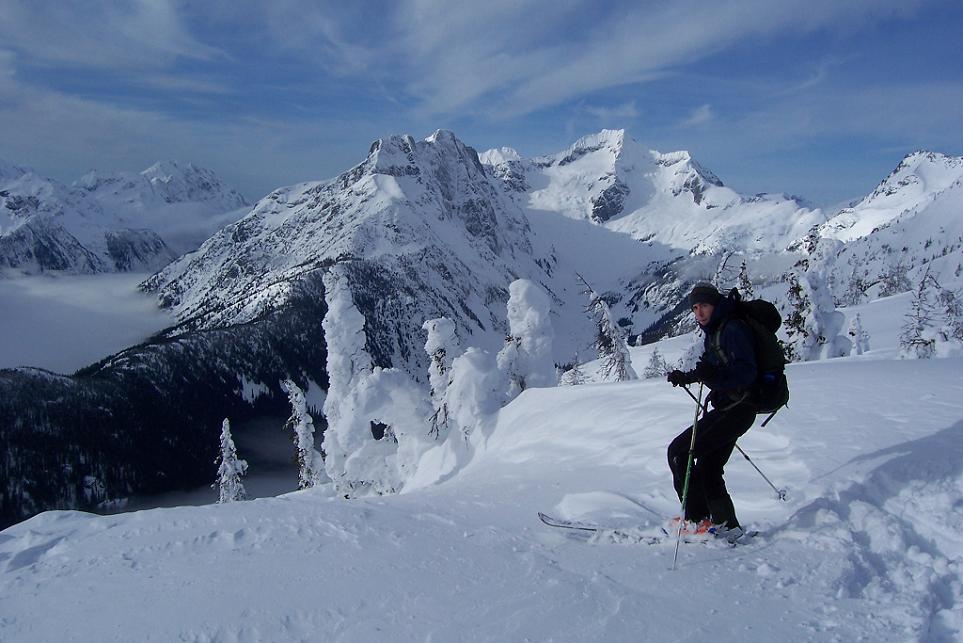 Skiing on Mt. Goode in the North Cascades


