- Camelback systems - These are heavy, cumbersome, hard to fill (relative to a bottle), hard to pack in/out of a full bag, horrible in the cold where they freeze up, bad amid bushwhacking, and make it hard to know how much of the liquid you've got left or have consumed. I'd only bring one if there's simply a long casual summertime hike into a basecamp area, from which I'd be doing short climbs. (Wind Rivers, Pasayten...)
- Quick Links - These get rusted shut and are hard to remove from the bolt that one uses them to bail from. Just bail from a wiregate with a sticky gate. It's far easier and doesn't require you carrying around a special "just in case" gizmo for months or years beforehand.
- Rap Rings - See above. When rapping from new cord or webbing, you don't need to leave any metal at all.
- 1" Webbing - Use ~5mm cord
- Nut Tool - For long routes or difficulty backcountry rock climbs at or near my limit, I often wont bring a nut tool. I don't place or fall onto too many small wires amid this kind of climbing, and don't mind having to leave the random piece behind if needed.
- Maps - Don't bring a paper map, download a super cheap phone map APP like "Topo Maps" - It lets you download all the maps for the area where you'll be, then you can put your phone in airplane mode, and the internal GPS will show you just where you are on the map.
- Water Pumping Gizmos - Drink from small feeder streams or tributary sources that are running from snow patches or terrain not crossed by popular trails. You'll be fine.
- Dishes (on serious multiday climbs) - Just eat a freeze dried meal from a durable pouch on day1, and then use the bottom half of that bag/pouch for future meals.
- Knife - It's easy to cut webbing or cord with an ice axe, lighter, cam lobe, or small rock. Just hold the piece taut and hack away.
- Pack Frame - Use your foam or inflatable pad and fold it into the frame sleeze.
- Hexes, Medium-Large Tricams, Cordelletes, Padded gear slings, Large Lockers, Snowshoes, Gaiters - Nerd Alert!
6.16.2016
10 Non-Essentials
I recently spoke at the Boeing Alpine Club in Seattle, which is a really supportive and enthusiastic group of climbers with a wide range of abilities and experience levels. It was fun to chat with the group, and one of the topics I was thinking about is the variety of items that I don't typically use or carry, but which many people bring along.


4.20.2016
Cascades Film
Over the past 2 months I've done about 12 slideshow events around the PNW related to the release of my new guidebook to the multipitch and alpine climbing in the Cascades. It has been great to see friends and meet new climbers everywhere from Bellingham to Beaverton and Spokane to Vancouver, BC. If you're interested in buying this book, you can get it here. At these events I've given a slideshow and then shown a film about climbing in the Stuart Range.
The subject of the film was a 24 hour alpine rock climbing marathon conceived by myself and Jens Holsten several years ago, when we realized that our 3 favorite area routes were all amazing new freeclimbs, all with roughly the same grade, and all on different mountains near our home. It would become our motivator to try and complete ascents of each of these peaks and routes in a single day from the car. The 20 miles of hiking and the necessary transitions and rappels meant that we'd have to do each route in under 4 hours. This wasn't something we were very confident in being able to do. A couple days before we set out to try it, we sat down for a beer at the brewery with local ski/bike/paddle photo and video guru Shane Wilder. Shane was moderately interested in the idea of a climbing film, but knew we'd need a lot of help. And as much as Jens and I though it would be rad to make a video, we weren't going shift the focus away from our climbing challenge by taking time or added weight required to film and pose down on our attempt, or go back and re-create stuff later. Fortunately, good friends Max Hasson and Shaun Johnson agreed to go film. Those guys did all the technical shots, achieved by climbing easier routes up the first and third mountains and fixing ropes from the summits toward where Jens and I climbed. The footage of the middle peak (Dragontail) came from distant shots that Shane managed from the trail, and our small point-and-shoot. (Dragons of Eden has spacious belay ledges). Without Shaun, Max, and Shane, this movie wouldn't have happened. It's the only film I know of that shows climbing in the Cascades. As these areas grow in popularity, let's all strive to keep them as clean and pristine as ever.
The subject of the film was a 24 hour alpine rock climbing marathon conceived by myself and Jens Holsten several years ago, when we realized that our 3 favorite area routes were all amazing new freeclimbs, all with roughly the same grade, and all on different mountains near our home. It would become our motivator to try and complete ascents of each of these peaks and routes in a single day from the car. The 20 miles of hiking and the necessary transitions and rappels meant that we'd have to do each route in under 4 hours. This wasn't something we were very confident in being able to do. A couple days before we set out to try it, we sat down for a beer at the brewery with local ski/bike/paddle photo and video guru Shane Wilder. Shane was moderately interested in the idea of a climbing film, but knew we'd need a lot of help. And as much as Jens and I though it would be rad to make a video, we weren't going shift the focus away from our climbing challenge by taking time or added weight required to film and pose down on our attempt, or go back and re-create stuff later. Fortunately, good friends Max Hasson and Shaun Johnson agreed to go film. Those guys did all the technical shots, achieved by climbing easier routes up the first and third mountains and fixing ropes from the summits toward where Jens and I climbed. The footage of the middle peak (Dragontail) came from distant shots that Shane managed from the trail, and our small point-and-shoot. (Dragons of Eden has spacious belay ledges). Without Shaun, Max, and Shane, this movie wouldn't have happened. It's the only film I know of that shows climbing in the Cascades. As these areas grow in popularity, let's all strive to keep them as clean and pristine as ever.
1.27.2016
Back to Chulilla, Spain
 |
| 'Chorreras' zone, with 'Masters' zone behind. |
Single-pitch climbing doesn't get much more fun, and Chulilla has a great lineup of classics. Most of the really world-class climbing is in the 7c-8b range (Basically mid 5.12 to hard 5.13). If you can climb .12- you'll have a good time, but there's not a lot of great (or uncrowded) climbing easier than that. I spent most of my time trying to onsight or flash routes. Mostly I failed at that, but did manage to do quite a few routes 2nd or 3rd go! Highlights were onsighting a 40+ meter super-soft vacationy 8a (even hanging the draws like a true vacationer), and sending an 8a+ on 3rd go.
 |
| Scopin' Lines |
Front Side (AKA Pared Enfrente wall, AKA the wall that faces the town) - We could see this wall form our balcony.
 |
| Allison and I. We need a selfie stick. |
Conflicto Territorial - 7a+/.12a Excellent technical stemming and pockets in a long warmup with a high crux.
Los Franceses - 7b+/.12 A double or triple-roofed corner with some crack climbing, leading up to 10-15m of overhanging tufa pinches and pockets.
Ramallar - 7c/.12+ A 40+ meter marathon! Amazing technical overhanging face climbing for 20m to a kneebar tufa, then 20m of tufas and pockets out a final bulge. A contrived direct finish variation is a bit harder. Skip the first few draws to make belaying easier.
Remanso de Las Mulas - 7c+/.13a Thin face climbing and commiting crimps lead into sustained tufa pinching and a hero finish.
Las Clochas de Targa - 8a+/5.13 Pumpy and sequential climbing for 25m (with a few rests) leads to an OK shakeout before suddenly confronting a relative slab crux, where barely-overhaning stone is dotted with too many tiny, upside-down holds. This is one is all about keeping it together as you probably wont be clipping the final bolt if you send via some tenuous trickery.
Entre Dos Caminos - 8a/5.13- Stellar twin tufa climbing to a rest, to some technical and blind cruxy climbing 10-20m up, to a rest. The final half of this route is immaculate and just hard enough to keep your attention, as folks were blowing the redpoint on the final few moves.
 |
| My friend Moritz and I went "Dawn Walling" - (rope trickery and bandalooping to reach the belay ledge) |
Back Side (AKA the mile-long shady wall that holds every "sector" from Pared Blanca to Masters)
 |
| There are about 100 amazing routes in the image. Note ropes hanging 50'+ out from wall. |
Plan Z - 7a/.11+ Excellent barely-overhanging technical face climbing.
Danos Colaterales - 7b+/.12 This one is 25' of thin, granite-ish techery, then an amazing long stretch of overhanging pockets and pinches, with a final crux gunning for the jug under the anchors as the holds get worse and worse.
Barrieros - 7c/.12+ The top route at the newly-developed Masters zone, on the far right (west) end of the gorge. This climb is world class, ascending dripping tufa flows past numerous roof and bulge features.
Super Cantina Marina - 8a/.13- An unforgettable marathon (43m?) combining technical tufa stemming, voodoo crimping, and steep flakes.
Nibelungalos - 7c/.12 Gently overhanging 30m of dripping pinches, pockets, small flakes, and some major committing movies with the chance for enormous airtime. Hardest moves are low down, but everyone was falling up high.
El Diablo Viste de Prana - 7c+/.13- Several cruxes include numerous places where you've got to fight or fly. There are some small/sharp pockets and a bit of real crimping on this one.
Planeta Namek - 8a/.13a This one is somewhat unusual for Chulilla in that it's got a definite stand-out crux down low (V5?). A couple of the higher moves were reminiscent of granite no-hands standups.
 |
| Steepness is evident. Climber on Tequila. |
El Bufa - 8a/.13b A powerful boulder problem off the get-go leads to a nice tufa-chair rest. The upper 35m is a marathon of minor cruxes, culminating in a committing compression boulder problem. Tie knots in the ends (or have the belayer tie in) even with an 80m.You've got to have a second rope handy to throw out to the lowering-off climber so you can reel them back in to the belay ledge.
Montana Magica - 8b/.13+ Basically a parallel and harder version of El Bufa, with sustained long reaches on crimpy .12/12+ headwall climbing up high. Tie knots in the ends (or have the belayer tie in) even with an 80m.You've got to have a second rope handy to throw out to the lowering-off climber so you can reel them back in to the belay ledge.
Los Veteranos - 8a/.13b This is a steep route by Chulilla standards, tackling a series of powerful roofs and bulges. Really gymnastic and powerful climbing! If using the tree just before the anchor isn't allowed, I guess I'm a Washington climber and couldn't help myself.
 |
| Myself exploding a foothold off Veteranos |
Super Zeb - 7c/.11+ This route is an excellent stemming and face climbing pitch right above the trail. And although it's 40m and never truly easy, I think it demonstrates the differences in style/familiarity for different climbers. It's a stemming feature and I swear it'd be .11+ at Index or Trout Creek (it gets .12+ in local grades). There aren't always handholds.
Altos, Guapos, y Fuertes - 8a/.13- This thing is powerful and bouldery down low, but doesn't much relent. You'll have to fight for any rests and keep it together on all 40m. One of the best in Chulilla.
Siempre Se Puede Hacer Menos - 8a/.13- I only climbed to anchor #1, there is an anchor #2 and a anchor #3. The whole thing is 64m and 5.14c. I was worked after managing the numerous cruxes and style switches on the 40m first pitch. Excellent, varnished stone and cartoonish tufa daggers.
 |
| High up on the Balcon sector, east end of the far gorge. Camera is tilted to make it appear slabby. |
12.01.2015
Cascades Rock : A New Guidebook

I wrote a book! It's been about 3 years in the making and is the product of thousands of hours of writing, editing, design work, and begging friends and climbers partners for beta-revision and to use their photos. I hesitate to use the term "select guide" because my goal was to include EVERY worthwhile alpine and alpine-ish (Snow Creek Wall, Darrington, etc) multipitch climb. I wanted all good routes of
All Grades
All Ages
Known Classics
New Obscurities
Across WA and southern BC
The finished product is 272 full color pages, 160 routes, dozens of topos that exist nowhere else, and interviews or contributions from well-known climbers and photographers.
Bad news: The books arrive for distribution in late January.
Good News: Everyone who orders before Christmas will receive a confirmation with the cover image, and an additional 4 pages of expanded descriptions, photos, and exclusive detailed topos for two routes that do not have illustrated topos in the book itself. (Serpentine Crack on Liberty Bell, and Davis-Holland to Lovin' Arms on Index's Upper Town Wall). This bonus is a way to thank anyone for pre-ordering the book, and will ensure that if you're buying Cascades Rock as a holiday gift, you'll have something tangible to put under the tree or in a stocking to keep climbers psyched until the new year!
Check out the website
11.18.2015
The Best Small Cams

I don't write much about gear. Overall there is a huge amount of good or great outdoor gear for whatever you want to do, be it fly fishing or ice climbing or rock cragging. Even the low-end stuff of today is probably better than the high-end stuff from 15 years ago. But one type of gear that DEFINITELY makes a difference is cams.
About 80% of climbers (and about 100% of climbers whose opinions should be trusted) prefer BD Camalots for cams thin-hand size and up. (#.75-#4) But in the smaller sizes, where placements get trickery, more finnicky, harder to inspect, easier to blow, and generally weaker, there isn't very much consensus. I learned to climb on a mix of cams, and still prefer a mix, but my favorite model is the Totem Basic Cam.
The Totem Basic is essentially a CCH Alien without all those pesky flaws (made in a garage by drunk Wyoming rednecks, tendency to explode under bodyweight...). The Spanish gurus at Totem took everything good about the Alien design (flexible, durable, works on 2-lobes for bodyweight, somehow alway seems bomber) and made them better by swapping in:
- An actual UIAA/CE certified manufacturing process where they don't forget to weld or braze the pieces together, and there is testing.
- The trigger wires are different and better than the old CCH version
- The Trigger is shaped and colored to match the cam, as are the lobes
- And the new BLUE ALIEN (AKA Blue Basic Cam) is much narrower than the old CCH, which was actually wider (even though it only worked in thinner cracks) than the old next size up, the green.
Old CCH alien (right) was really wide, yet only fit into thin cracks. That was fixed with putting spring inside the lobes, and making the end-caps slimmer.

Another Spanish company, FIXE, also is making similar models. They actually bought the rights to legally call their cams Aliens. But despite making good bolts and hardware, their FIXE Aliens are atrocious, with lots of pretty obvious problems.
 |
| This (FIXE model)is NOT the alien you're looking for... |
I've bought a full set of the Totem Basics online from Rock&Snow, a shop in New York which shipped free across the USA and charged no sales tax. They often have 20% off sales. Backcountry.com stocks totem basics and has these sales often as well.
 |
| Totem Basic and BD C3. BD is narrower, Totem is more flexible. They contrast nicely. |
I think the perfect small-cam rack is a set of BD C3 cams from purple to Yellow (they are stiff, really narrow, and a good contrast to the Totems), a set of Totem Basics from Blue to Red, a a couple of the offset Totem Basics (blue/green, green/yellow).
 |
| Totem Basics (green is shown) are slightly narrower, and more flexible/durable than the BD X4 cams. |
 |
| This (Fixe model) is NOT the Alien you're looking for. These breakage happened one day1 with mine and many others. |
9.28.2015
Supercave Wall Free Route
Over the course of 3 days this summer, my friend Max Tepfer and I freed the original 1969 route on the Supercave Wall near Washington Pass, just east of Liberty Bell. I had previously sent what would become P4 of this route at ~.12b, and thought it would all be easy below that. However, at a leftward traverse which had been done at A4 via upward-driven knifeblade pitons, we were stymied and unable to send. With cooler temps and some clouds in the sky, we freed this section at 5.12- and it involves a horizontal slab dyno to a fishbowl hueco. Not your normal granite slabbery.
This route was put up by some true PNW hardmen who climbed it with about 1.5 billion pitons (some of which we removed) and 1 bolt. We added 3 protection bolts (these sections had been done at A3 or A4 on pitons) with the permission of Jim Langdon of the FA.
The route is definitely a modern classic and features flawless stone and some amazing pitches. Here are a few photos and a topo:


This route was put up by some true PNW hardmen who climbed it with about 1.5 billion pitons (some of which we removed) and 1 bolt. We added 3 protection bolts (these sections had been done at A3 or A4 on pitons) with the permission of Jim Langdon of the FA.
The route is definitely a modern classic and features flawless stone and some amazing pitches. Here are a few photos and a topo:


5.13.2015
Rock & Ice Classics
In the past few months I've gotten out and climbed on a few trips to classic areas that were new to me: Yosemite and the Canadian Rockies.
Before those trips I managed the FA of a really fun thin face/bouldering pitch at Trout Creek on the day thatthe wall closed for the seasonal eagle nest intermission. I love crosswords, and crossword-puzzle-builders love the word "Aerie" - which is an eagle nest. The route was named "aerie interlude" in deference to my crossword obsession and the much more famous "Airy Interlude" in the Needles of California. It goes at .12d or so (V5 to a V6/V7) and protects with very thin but bomber cams and wires. Again, no bolts have been used or needed on any route at Trout Creek. Trout opens back up for climbing in a few days (May 15) and I definitely suggest this climb, even just as a great end of the day TR after climbing Gateway or one of the 5.10 routes over to the left.

Jens Holsten and I took a trip to the Canadian Rockies to climb some long classic waterfall ice routes, and we were graciously hosted by our friend Steven Swenson who fit us into his schedule of guests and itinerant dirtbags who overwhelm his condo in Canmore Alberta.
We were both amazed by the scale, beauty, and access of the peaks in the Rockies. The ice was fat and blue. Screws actually would hold a fall. This was not Washington slush ice. The first day in the area Jens and I climbed Carlsberg Column in the Field, B.C. area, and then we stopped by Lake Louise and strolled past the amazingly ornate lodge, walked past kids skating and playing hockey, and found ourselves under Lake Louise Falls, which we climbed as well.
The second day we drove up to the Icefields Parkway and began to climb the Weeping Wall, but realized that there was a reason we had the place to ourselves - the ice was turning white and getting sun baked. After reserving a spot at the Rampart Creek Hostel, we backtracked to the trailhead for Murchison Falls, and climbed a route just left of Murchison, a stunning and scenic WI5 called "My Daddy's a Psycho". By "we climbed" I really mean "Jens climbed" -- I basically lead the easier (WI3 and WI4) pitches, while Jens took the WI5 pitches.
After a sleepless night in the noisy and sauna-like atmosphere of the hostel bunk room, we got up early and climbed the amazing Polar Circus route, a long and ever-steepening series of frozen waterfalls that is among the most famous ice climbs in the world. After driving back to Canmore and resting for a day, Jens and I were joined by Ian Yurdin of Bend, and our guide/rally car driver Steve Swenson for a trip into the fabled Ghost Valley on the eastern front range in Alberta. Steve's Subaru Outback made it pretty far, despite falling snow, large drifts, semi-frozen river crossings, and 3 terrified passengers. I realized that I had forgotten my crampons, but Steve realized that he had climbed our intended route 3 times already this year, and was happy to let Ian join Jens and I on the climb. We completed a very cold and snowy ascent of The Sorcerer, complete with frozen eyelashes and eyelids on the final steep headwall pitch.

----------------
Later this spring, I final made a trip to Yosemite where I had the amazing opportunity to climb the Zodiac Wall on El Capitan with Dan Nordstrom who owns Outdoor Research, and with Maria Hines, who owns 3 of the premiere restaurants in Seattle, not to mention being a champion of the Iron Chef TV show. I was mostly along for the ride as a dabbler in all types of climbing, but I learned a lot about hauling, portaledge camping, dawn-walling, harness-sleeping, and aid sketchery. The most memorable event was catching Dan's near-factor-2 fall midway up the route, as his GriGri and 1 jumar were knocked off his harness and free-fell over 1,000' to the deck. The Zodiac Wall is steep, and water falling off the final pitch lands dozens of feet out from the base of El Cap on its steep right side. After a couple days of resting/cragging/bouldering I teamed up with new friend Ricardo Varga, a Mexican sport climber from Portrero Chico, who was just learning to trad climb. We rallied up the classic Astroman, despite getting jammed up behind (5!) teams on a wednesday, including a Euro party engaging in classic Euro shenanigans such as laybacking all the cracks, yarding up a haul bag, and falling out of the Harding Slot and spending hours dangling in space under the gaping maw. I got to lead the whole route apart from an approach pitch, and felt good about on-sighting the famous climb and my first real Yosemite experience. 5.9 is physical, hard, and calorie-intensive in Yosemite!
 |
| Chris Tirrell working the line |

Jens Holsten and I took a trip to the Canadian Rockies to climb some long classic waterfall ice routes, and we were graciously hosted by our friend Steven Swenson who fit us into his schedule of guests and itinerant dirtbags who overwhelm his condo in Canmore Alberta.
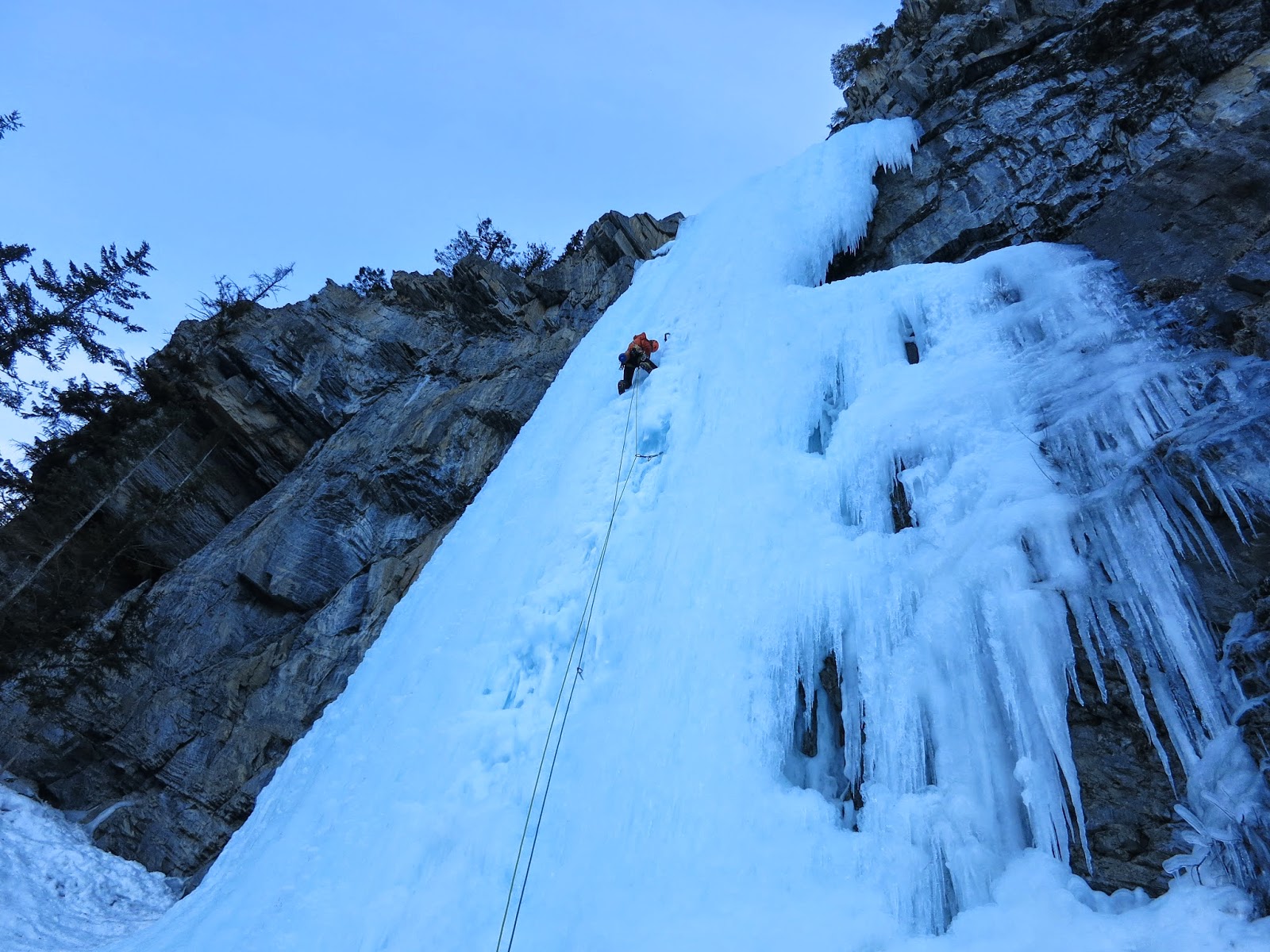 |
| Jens gets us going on Carlsberg Column near Field, BC |
We were both amazed by the scale, beauty, and access of the peaks in the Rockies. The ice was fat and blue. Screws actually would hold a fall. This was not Washington slush ice. The first day in the area Jens and I climbed Carlsberg Column in the Field, B.C. area, and then we stopped by Lake Louise and strolled past the amazingly ornate lodge, walked past kids skating and playing hockey, and found ourselves under Lake Louise Falls, which we climbed as well.
 |
| The view from one end of Lake Louise |
 |
| The other end of Lake Louise |
 |
| Jens on a WI5 pitch of a Murchison Falls variation |
 |
| Murchison falls is 1-2 miles above the road in a beautiful setting |

----------------
 |
| I heard they designed that rock based on the North Face logo... |
 |
| Ricardo follows the Enduro Corner on Astroman |
 |
| Ricardo on the Changing Corners pitch |
 |
| Slotting myself into the belly of the beast, and executing the 180-degree turn. Index flares have taught me well! |
 |
| Laybacking under the Harding Slot |
2.16.2015
Southern Spain - Jaen & Cordoba
.jpg) |
| James Lucas photo - last climb of the trip |
 |
| Typical Spain: olive orchards, goats, multiple 5.14 climbers, and some americans trying not to flail too hard. |
We climbed for a few days on massively overhanging limestone walls, working routes despite very cold weather. We had a small fire at the crag a couple of days, and experienced several snow squalls, but stayed dry. The final day, we arrived to find meter-long icicles hanging from many of the tufas. I asked Pedro what the Spanish word for icicle was, and he claimed that there wasn't one (at least in common usage in Andalusia) - it was basically something that never happened around there.
.jpg) |
| Looks steep up there, better use the kneebar sleeve. |
 |
| Hazel on Lagunas Mentales |
 |
| James lowers off Conde Dracula |
 |
| Very little of the climbing is bouldery, but Pedro stuck the dyno this thing this (V10? / 5.hard) |
 |
| James on the tufa rest |
 |
| Pedro's amazing house in downtown Cordoba, next to ancient castles, mosques, and bridges. |
 |
| Plant grape vine in gutter. Wait 3 generations. Harvest grapes and wine from the roof. |
 |
| I am very gluten tolerant. |
2.01.2015
Chulilla Spain
 |
| Ciudad de Artes y Ciencas, Valencia Spain |
Chulilla is an ideal spot to tick mega enduro pitches in the .11+ to .13+ range, with endurance being the name of the game on gently overhung waves of tufa-draped stone. The only thing it doesn't have is a big cave, or excellent low-grade climbing. From the tiny town (one bakery, one bar, one town square, etc etc) it's a 5-40minute walk to all the walls. I managed to onsight a couple 5.12c pitches early on, and topped off my week in Chulilla with a flash of the 40m .13a "Remanso de las Mulas", my first flash of that grade. My final day, I sent the area classic "Tequila Sunrise" (.13a/.13b) second try. (Video at the bottom of thsi post)
Here are a few psyche-you-up videos (not mine) that capture the area, and some of my photos. Valencia is also an amazing town, only 30 miles away, and with excellent rest day touristing opportunities, particularly the old castles, downtown region, huge central food/seafood market, and the City of Arts and Sciences.
Overall I HIGHLY recomend Chulilla for a visit, since you don't need a car once you arrive, the climbing is killer, there are hundreds of routes within a walk from the quaint town, and it seems to be dry and pleasant here all the time, even when it was storming hard and raining/snowing a couple hours north in Catalonia.
 |
| My array of ticketing/lost bag material - que lastima! |
 |
| Chris Allen and I streaming the superbowl on a tiny computer after hacking into the interwebs (we weren't supposed to stream it from Europe.) |

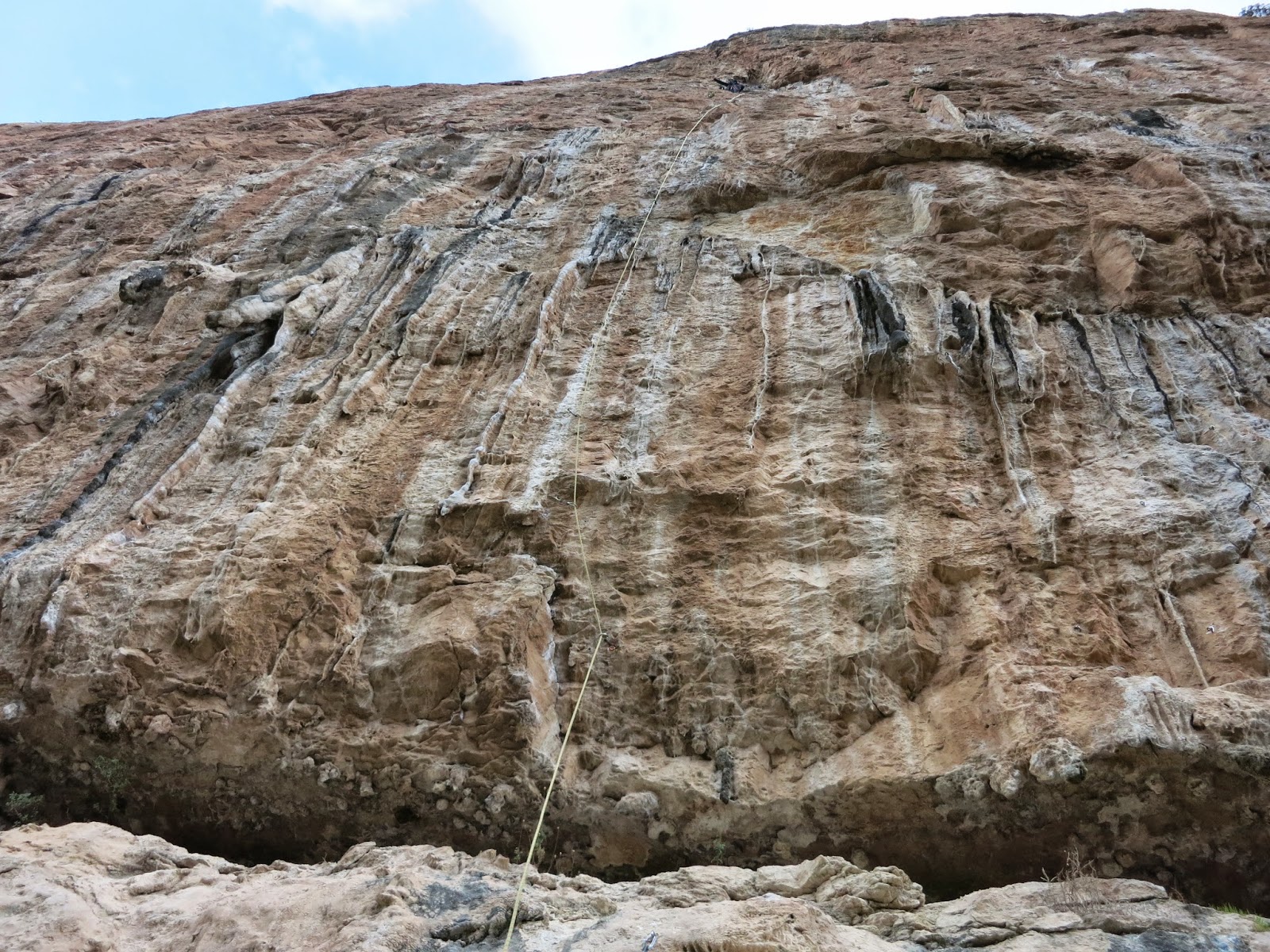 |
| Tequila Sunrise 5.13- (It's actually overhanging the whole way) |
 |
| Cobra Tufa atop the 40m masterpiece "Ramallar" 7c/.12d |
 |
| The Chulilla Gorge |
Piotr Bunsch climbing Primer Asalto (8c) in Chulilla, Spain from Valencia Climb on Vimeo.
veteranos from mugiwara on Vimeo.
Subscribe to:
Posts (Atom)