5.12.2010

The Meaningless "R"

It SNOWED in Denver yesterday (middle of May, mind you...) so I'll blame my purely-critical bloggery on the gloomy mood outside. Perusing the internet this afternoon, I came across a link to Hazel Findlay making the first female climb of Air Sweden in Indian Creek. And that's awesome. Air sweden follows a thin-hand and ringlock crack (Sweden-Ringle 5.12), then where the crack temporarily peters out (and Swedin-Ringle ends), one must use the incipent crack features and the nearby arete to continue straight up for ~3 body lengths without gear, until the crack reopens. This crack is then followed shortly to a second bolted anchor.

My problem? Air Sweden is "5.13 R"

I've always understood an "R" to mean that a fall is likely to result in injury. Hence in all but the most unusual of mountain circumstances*, I think adding an "R" is completely redundant when grading an alpine route, as very few don't feature some "fall and you're gonna get hurt" climbing.

Being above one's gear on a vertical or overhanging pitch is one thing, but climbing above one's gear with a strong likelihood of serious inury from a fall? That's something else. And it's something I generally seek to avoid. I don't want to just guess if that "R" stands for "rescue & evac." or "really clean airtime."


"I fell slapping quite high in the slot on my
second attempt, but it is a nice clean fall."


Dozens of climbers have been on Air Sweden, many of them falling repeatedly on film. (And here and here...) but not a scratch among them. It's not a dangerous route, and it shouldn't be "R" rated.

*an example of when I understand giving your alpine route an "R" rating is when falling from the route's crux, especially if it is several grades harder than anything else, would result in injury. A 5.11+ R with sketchy 5.9 and a well-protected 5.11 is different than a 5.11+ R where missing the crux onsight lands you in the hospital.

5.11.2010

Knowing it all...


A couple years ago, my friend Brandon Workman and I climbed Index's Upper Town Wall via the 5-pitch sport climb called The Golden Road. A new route, the first pitch featured bolts next to a crack, with every other pitch being bolted face climbing. The first pitch also seeps water long after the upper pitches dry out, and it's not unusual to pull on bolts or a cam to get through the p1 wetness. That's what Brandon and I did, which had me remarking that the bolts on this pitch weren't even needed. I knew cracks shouldn't be bolted, and that-was-that. I mentioned it to a couple friends at the time.

And I was way wrong. Those bolts were placed to prevent folks from having to use the crack, which ran along the left-side of a solid-looking, but fully-detached block. A week ago, the Index guidebook author and climbing partner levered the whole block off the wall, while aiding through that section on a #3 friend. This is the exact same thing
Brandon and I had done, and with gear in the very same crack that I said should make those bolt unnecessary. Maybe the first ascentionist, someone who'd climbed at index for years and spent hours on the route, did actually know the rock a little better than a 21-year-old kid who did the climb one time. It's a good reminder...


There are few people who are more often in the wrong than those who cannot endure to be so.
Francois De La Rochefoucauld

5.07.2010

You go Looking for an Adventure...


And you might just find one.

First Creek Canyon. Lady Luck reaches the dark band, Celtic Cracks is above.

One of our climbs in Red Rock proved to be obscure for reasons beyond the long approach and byzantine descent. It was also among the most memorable.

In an effort to try a few 'modern-moderates', Garrett, myself, and Rad Roberts hiked into First Creek Canyon, aiming for the 1000' slab climb called Lady Luck, and planning to link that into the 1000'+ Celtic Cracks on the Labyrinth Wall, which looms above the slabs.

For this day, our third in the canyons, the wind never gusted above 40MPH, a welcome change from the tempestuous chaos of prior outings. In fact, we all thoroughly enjoyed the calm on our first 7 pitches, lulled into a sense of complacency by the mellow climbing, solid stone, and sunny weather on the enjoyable Lady Luck.

While we snacked on a ledge, dark clouds flew in over Mt. Wilson, reminding us that Spring in the desert does not reward complacency.


By the time Rad lead the first pitch off the ledge, a steady mix of snow and hail covered positive handholds and ran down the cracks.By pitches 3 and 4, more than frozen precip would be falling.


Pitch3 of Celtic Cracks follows a left-arcing corner, which becomes a roof on the route's signature pitch. Unfortunately, this roof pitch sheltered us from falling snow only to shower us with falling dirt, gravel, flakes, and climbers.


Garrett knocks debris at Rad, scores several hits

Above this pitch, a short vertical sandbox brought us to a 600' offwidth and chimney crack. Snow continued to spit on us as for the 3 final pitches, where multiple 40' runouts, questionable flakes, and some stretches of suprisingly OK climbing crested the wall.

Bushwack canyoneering down a complex network of gulleys and rappel points provided ample time for contests like "what plant is poking me now?" and "who's got the most thorns in their boxers." Reaching our backpacks at Headlamp:30, we crowned Red Rock wildnerness as the day's only winner.

5.04.2010

Making it Happen

Today was the 7th consectuive day of climbing in the most remote parts of Red Rocks. Lots of 12+ hour days and amazing routes. We haven't shared a route with another party yet, and usually have our entire wall (or canyon!) to ourselves.

Here's Scott Bennett sending the roof on "The Breathing Stone"...


See the B&W photo below for the perspective on the pitch. I'd lead as well, with Garrett Grove following for the top-down photos of Scotty sending...

Lots more cool videos, stories, and photos of our 70+ pitches to come later.

4.26.2010

Perfect Pitch


The coach of my crew team in high school had a big impact on my life as an athlete and as a person. Whenever I can't summon up the motivation for an alpine start or trip to the gym, I remember Bill and become re-inspired. One of his (numerous) wise sayings, is that "The perfect stroke has never been taken." In a 2-kilometer race, we'd take over 200 strokes, so knowing that each one of these could be improved was something that stuck in the mind of an impressionable 16-year-old.

And I think the principal applies to much of our lives. Has the 'Perfect Pitch' ever been climbed?

Dave Evans on the first (and likely one of the few) ascents of the Breathing Stone - Western Spaces Wall

I'm off this evening for an 11-day trip to Red Rock National Conservation Area. On the "to-do" list is a freeclimb of the well-known Rainbow Wall, and an additional dozen routes that we're hoping most climbers haven't done, or haven't even heard of.

The Breathing Stone, Line of Addiction, Enterprise, and Ancient Futures... these are just a few of the long, difficult(for me), and potentially excellent routes that lie hidden on the park's lesser-visited walls. But with a long list of climbs, mostly following a 1-3hr approaches, this will be a good test of my fitness and ability to climb hard day-after-day. With the RPs, offset nuts, screamers, and lots of extra tat packed away, I'm ready to have an adventure! And to have the energy and psyche to punch it through that runout on day 9 and pitch 100, I just need to work on climbing some perfect pitches. Starting tomorrow...

4.13.2010

Mountain Climbing

I was recently asked by someone I'd just met "What kind of climbing do you like to do?"

I didn't have a very good answer. Or rather, I didn't have a very good way of saying my answer. I responded that I mostly enjoyed "mountain climbing" and left it at that, probably a pretty vague and unsatisfactory answer to what seemed a straightforward question. But I came across a quote from John Muir today that would have been a more apt description of why I most enjoy heading for an adventure in the alpine.

Thousands of nerve-shaken, over-civilized people are beginning to find out that going to the mountains is going home, that wilderness is a necessity, and that wilderness parks and reservations are useful not only as fountains of timber and irrigating rivers, but as fountains of life.

Of course, if I'd answered with all of that, I'd really have gotten an odd look.


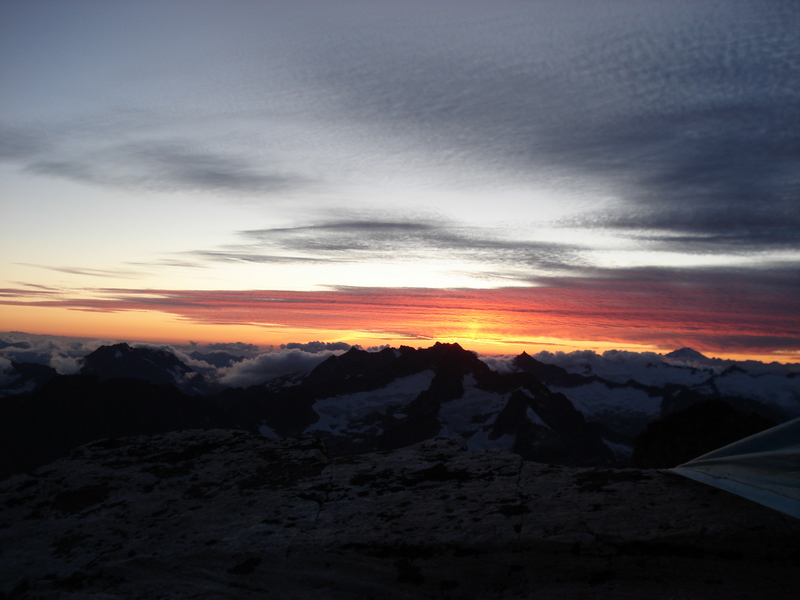
Sunset bivy from the highest point in the North Cascades National Park, after 2 days of mountain climbing with my friend Sol Wertkin. We were "living the dream" before the 20-something mile return to the road the next day.

4.07.2010

Neat Old Junk


Climbing a route, any route, allows the modern-day alpinist to compare his or her ascent to the prior ascents of a given peak. And for a history nerd such as myself, it's compelling to think about the same climb being done with the different technologies and techniques of past years or past generations.

Through an inability to stay on route, and the intentional desire to wander off the beaten path, I've come across an interesting array of climbing relics. Some of these I picked up in the North Cascades (old pitons in the Gunsight Range, probably from Fred Beckey's 1940 or 1967 trip) and others from Patagonia, New Zealand, or the desert Southwest.

Here are a few of the random little trinkets I've held on to:

Carabiner with no strength rating, UIAA certification, or any of that modern mumbo-jumbo. This was probably the precursor to the European brand Simond.

"Claudius Simond Chamonix"

Pitons from one of three trips to the Gunsight Range in the North Cascades. Dan Hilden and I thought our packs were heavy when we had to contend with hundreds of blown-down fir trees on the trail portion of the approach. I can't imagine doing the same trip with canvas rucksacks full of iron pitons.

Fred's AAJ entry from this second expedition to the range is so good, I have to include part of it here:

Four of us lost almost a day in just getting across the south fork of Agnes Creek, finally climbing a slippery log in a thundering canyon with the aid of about six
pitons. We then set up a tyrolean traverse from trees at a different location
for hauling packs and for the return trip out. In between these
exasperating episodes I was chased by a black bear. TO make matters
even more hectic,...


A Chouinard Hex. Moss has grown over the knot, but the part of the cord that was not exposed to sun still seems pretty strong. This came from an ascent of "The Passenger" last summer, on South Early Winter Spire.


Original flat-sided Chouinard #4 "Stopper"


And the most recent addition, a #6 "Titon" which was something invented by Kris Walker and Bill Forest. Perhaps the little tree with a "W" stands for "Forrest/Walker"? This was found on the route Jupiter II in Red Rock, along with a straight-sided stopper, stamped with the initials VB (likely for prolific Red Rock climber Paul VanBetten).

This Titon says PH on it, but I've got no clue who that is. I'm glad we're not all pounding our initials into our gear these days...

3.29.2010

Tired Soles


I can locate the holes in my shoes by the presence of desert-red dust stains on my formerly-white socks. Slipping them off for my umpteenth time, I wonder how many more days I can coax from them. The structure is more Seam Grip than original rubber, and the foam along my heels has long since worn to nothing or been warped by the heat of too-close campfires. They’re starting to fit just perfectly.


It’s funny how we develop these emotional attachments to inanimate objects. One friend refuses to rock climb without his particular Orange Alien cam, a specimen so worn down and fallen-on, that it fits spaces too small for its original dimensions. So is it the cam he likes, or the memory of hundreds of past adventures? And am I reluctant to trash my foul-smelling shoes because I really want to wrangle one more alpine trip out them? Or am I just afraid to divorce myself from all that they’ve carried me through?


I bought the shoes from La Sportiva’s clearance rack, 20 months ago when I lived in Bellingham, worked for McNett, and still thought those people with blogs were nothing but hopeless narcissists. (Hey, some things don’t change). I’ve paid about $1.20 per month-of-use. And they haven’t exactly been sitting in my closet. The cost per pitch would likely be measured in fractions of pennies. I’m not sure if they were marketed as Running shoes, Hiking shoes, Approach Shoes, or just the good old around-town variety that everyone keeps handy. They’ve served these purposes and more.


They’ve waded Zion streams with Kurt, and tackled Rocky Mountain linkups with Kelly, they’ve tramped up to Cerro Torre with Jon, and pounded the streets of Alaska with Jason. And their soggy and icy forms held my numb toes during an unforgettable night with Sol and Jens.


But they’ve also been there to play volleyball at one wedding (my own) and to run 15 miles into Stehekin for the wedding of my friends Chelsea and JB. They remind me of how much change I’ve witnessed since their purchase, both in my life, and in the lives of those close to me. And the thought of getting rid of them makes me miss the times before these changes.


So I’ll dig the tube of Seam Grip out of or freezer and go to work, hoping to keep the shoes alive for just a little bit longer. I’m just not sure exactly what it is I’m preserving…


3.25.2010

Red Rock Renaissance


Las Vegas sucks...

Take all the worst stereotypes of modern America, the homogenous suburbia, waste of non-existent resources, and glorification of consumption, and you paint an accurate picture of the city's foundation. Luckily for the climbers and adventurers out there, 20 minutes from the strip you can trade in poker chips and neon lights for varnished sandstone and deep canyon sunsets.

I spent the last week in Red Rock National Conservation area, including getting to climb for a day and a half in between teaching classes and doing some photography rigging. It was my third trip to Red Rock, and I was more inspired than ever to head up some of the seldom-trod climbs on hidden walls. Both personal days featured perfect rock, and good friends (Kurt and Alasdair, AAI guides from Washington state). And during Red Rock's peak season, the height of Spring Break and the Red Rock Rendezvous, we didn't encounter a single other climber. I don't mean on our routes either. I mean not a single other climber at the entire walls on which we climbed.


Bellingham-ster Garrett Grove and I are returning to Red Rock in late April to climb, photograph, and research some of the area's best obscure routes. Look for an eventual article in Rock & Ice.

3.08.2010

A Week's Worth of Work


Learning to climb in Stehekin and Bellingham, I never had a "local" crag. And I still don't have a local crag, now I have hundreds! Last week was a climbing smorgasbord, with 6-consecutive days out, doing everything from bouldering to ice climbing, and long trad pitches mixed with short sport routes.

Here are a few shots from Le Void in Eldorado Canyon State Park. Every time I climb there, I appreciate the place more and more. Not for the high-quality stone or striking lines (gotta go elsewhere for these) but instead because the walls are so enjoyably climbable! Small seams, flakes, knobs, and edges cover all the walls, creating far more (excellent) routes than immediately meet the eye. Le Void follows a long corner crack as the moves turn from 5.9 to 5.10 to 5.11-. After a rest stance, one launches up an overhung flake, arms spanning to both sides, until you've got to commit to a few tenuous 5.11+ moves up over the flake and to another stance. From here, the rock changes from perfect to downright Cascades-esque, and Josh removed a "fixed" piton by hand while AOing through the 5.12 roof to finish off the 160' pitch. I followed and still couldn't figure out the roof sequence, but nervousness about using 1/2 of the available holds may have played a part.


To reach Le Void, we'd done Guenese through the lower roof. Here's my friend Scott hiding his eyes in shame after pulling the roof.


And more of Josh leading Le Void...


The beautiful colors of the lichen really shine in the evening light. However, evening's the time I'm cutting lemons and slicing focaccia bread at my restaurant job these days, so some early-afternoon washed-out shots will have to do.


Another day was spent ice climbing at Hidden Falls, which is just inside Rocky Mountain National Park, and reached by hiking* for a couple miles from a trailhead between Lyons, and Estes Park.

The waterfall gets climbed so much, that one doesn't even need to swing ice tool, but just place them into the many holes that other climbers have already created. It felt like climbing 5.7 rock with giant holds. But I can't really complain about too many climbers, since I was one! I was with a friend named Camilo Lopez who does expedition-style climbs around the world. This movie was created by Camilo's friend Luke, who had his first day of ice climbing at Hidden Falls that day. I think Camilo intends to use the clip for his guiding business.


At 1:53 you can see my patent-pending gear modification, in the form of a pastel-pink chunk of microfiber towel, Seam-Gripped onto my glove. My nose always runs in the cold and now I've got the fix. The trick is finding a spot that wont get torn off when you've got to bust out the gloved hand jam or other snowy grovelling.


The dry El Nino winter has been good for climbers, and bad for glaciers. It's kept approaches fairly manageable and skies fairly blue in the northwest. Local alpine heroes Wayne Wallace and Tom Sjolseth have both had really successful winter seasons in the notoriously difficult Cascades. For some beautiful photos and inspiring climbing, check out Tom's pictures from Chair Peak or his First Ascent of Assassin Spire, and Wayne's new routes on Pyramid Peak & Mt. Hood.

And my fellow Western Washington University Alumni Nate Farr has had a pretty good winter season as well, including a recent probable new route on Illumination Rock. Even better, Nathan and I were just awarded the American Alpine Club McNeill-Nott grant, for a trip this summer.

*according to Demetri Martin, hiking is just walking where it's ok to pee. I like this definition.